Mood Trackers Without AI: The 2026 Counter-Trend, Mapped
The MoodKit Team
· 5 min read
Two years ago every mood app raced to bolt on a chatbot. In 2026 the race has a countercurrent: people typing “mood tracker without AI” into the App Store, and researchers handing them reasons. Studies covered by the Alliance for Connected Care and others document real privacy and safety problems with AI mental-health chat, several states passed laws in 2025 restricting AI from playing therapist, and the FTC has gone after apps overclaiming what their bots can do.
You don’t need a policy opinion to act on this. If you’d rather your feelings never met a language model, here’s the AI-free field as it stands. (Disclosure: we build MoodKit, first below, and the no-AI stance is one of the reasons it exists. Facts checked August 2026; US pricing; feature sets drift, so re-check listings before buying.)
What “no AI” buys you, concretely
- A smaller blast radius. Text you never send to a cloud model can’t be retained, breached, or used for training there. With on-device statistics, the analysis happens where the data already lives.
- Explainability. A correlation comes with its inputs: this activity, these days, this average difference. You can audit it against your own calendar. A chatbot’s paragraph, you just have to trust.
- Stability. Statistical insights don’t hallucinate, and they don’t change personality after a model update.
The trade: nobody talks back. If what you want is a reflective conversation, an AI journal genuinely delivers something these apps don’t. That’s a fair preference; it’s just not this list.
The AI-free shortlist
| App | AI in the product? | What analysis you get | Price model |
|---|---|---|---|
| MoodKit | None, stated outright | Ranked activity impacts, weekday rhythms, combo patterns, self-experiments | Trial, then $39.99/yr or $79.99 lifetime |
| Daylio | None advertised | Averages, activity-mood correlations, streaks | Free tier; $35.99/yr or $59.99 lifetime |
| Pixels | None advertised | Year grid, tags, descriptive charts | ~$4.99 one-time (+ optional cloud sub) |
| eMoods | None advertised | Printable clinical-style reports | Free; $9.99/yr tier |
| Apple State of Mind | On-device, no chatbot | Charts, simple associations | Free, built into iOS 17+ |
Facts checked August 2026.
MoodKit
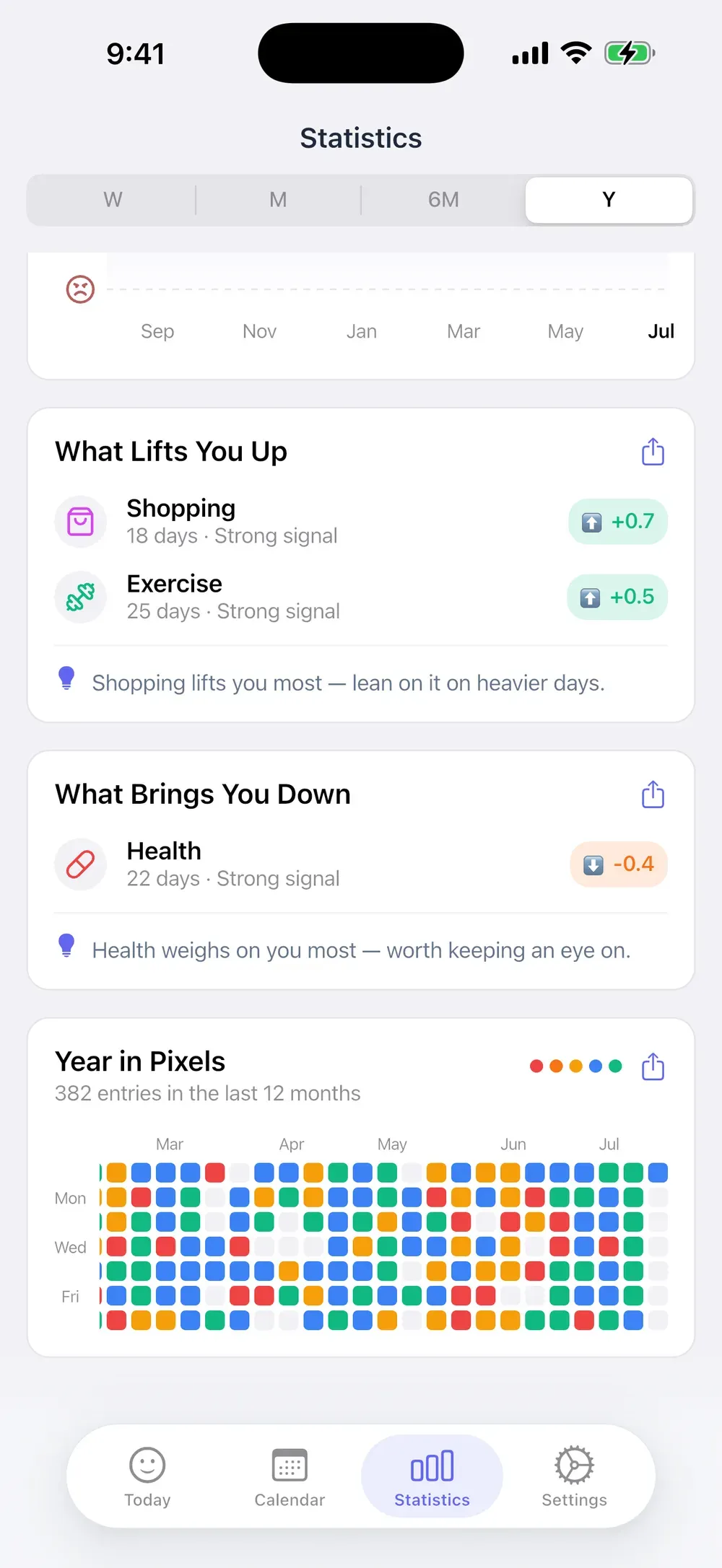
MoodKit puts the position in its own App Store description: “no AI, no cloud analysis, no black box.” Every insight, from the Impact Leaderboard that ranks your activities by measured mood effect to the Hidden Patterns that flag surprising activity combinations, is classical statistics computed on your device. Mood entries never leave the device; analytics covers app usage and crashes only. There’s no account to create, it works offline, and self-experiments give you an honest verdict on habit changes from your own numbers.
- Best for: people who want deep analysis and the no-AI guarantee in the same app.
- Watch out for: no permanent free tier (trial, then $39.99/year or $79.99 lifetime), iPhone/iPad only, and it’s a young app next to the decade-old incumbents.
Daylio
The category veteran (4.77 App Store rating, August 2026) advertises no AI features and keeps its analysis counting-based. Its free tier is real, its stats are shallower than its data deserves, and we’ve written up where it wins and loses at length.
- Best for: a free, proven, AI-free starting point.
- Watch out for: insights stop at correlations; the “why” work stays manual.
Pixels
A one-person indie app built around the year-grid. No AI, no account needed, essentially a beautiful manual journal with descriptive charts. We covered it in the Year in Pixels round-up.
- Best for: minimalists who want the grid and nothing watching over it.
- Watch out for: descriptive stats only, and no widgets or Apple Health tie-in.
eMoods
Built for clinical mood charting, deliberately boring, and AI-free. Its printable reports are designed to go to a human professional, which is arguably the strongest anti-chatbot stance there is.
- Best for: structured symptom-style tracking to share with a clinician.
- Watch out for: dated interface, one entry per day, zero interpretation in-app.
Apple State of Mind
Free, on-device, no chatbot, already on your phone. It also collects more than it explains, which is the whole gap third-party apps live in.
- Best for: testing whether mood logging sticks before paying anyone.
- Watch out for: no custom factors, no ranked drivers, iOS 17+ only.
The apps this list is reacting to
Naming the other side keeps this fair. Reflectly puts “AI Diary” in its App Store title, and Rosebud is an AI journal top to bottom; both are competent at what they promise, and what they promise is the opposite of this page. How We Feel, a genuinely lovely free app, added AI features that pushed some of its own fans to look elsewhere. If you’re leaving one of these, the Reflectly exit guide walks through the moves.
Picking from the shortlist
Want the analysis without the chatbot: MoodKit. Want free and familiar: Daylio. Want the grid and silence: Pixels. Charting for a clinician: eMoods. Not sure you’ll stick with it: start with Apple’s built-in logging, then upgrade when it stops answering your questions.
One closing thought, since we’re openly a party to this argument: “no AI” shouldn’t be a vibe, it should be checkable. Look for on-device processing, no required account, and a real export button. Those three are hard to fake, and the private mood tracker guide shows how to verify each one yourself.
Frequently asked questions
Why would anyone want a mood tracker without AI?
Three reasons come up again and again: privacy (your feelings become training data or cloud-processed text), trust (you can't check how a chatbot reached its conclusion), and regulation (several US states restricted AI acting as a therapist in 2025). A statistics-based tracker avoids all three by design.
Does 'no AI' mean no insights?
No. Correlation, ranking, and trend math don't need a language model. MoodKit's whole insight engine, for example, is classical statistics computed on the phone. What you give up is conversational output; what you keep is the ability to see why every insight says what it says.
Is Daylio AI-free?
As of August 2026, Daylio advertises no AI features. Its analysis is counting-based: averages, correlations between activities and moods, and streak stats. As with any app, re-check the current App Store listing before you commit, because feature sets change.
What about Apple's built-in State of Mind logging?
Apple's Health app logs emotions on-device with no chatbot involved, and it's free. It collects more than it explains, though: you get charts and simple associations, not ranked drivers or experiments.
Keep reading
Best Private Mood Trackers in 2026: On-Device, No Account
Mood data deserves real privacy. The trackers that keep entries on your device, skip accounts, and avoid AI — plus how to read a privacy label yourself.
· 4 min read

Reflectly Alternatives Without AI (2026): 6 Honest Picks
Leaving Reflectly over the price, the stagnation, or the AI? Six alternatives compared — including trackers that never send your feelings to any model.
· 3 min read

Apple's State of Mind vs MoodKit (2026): Built-In or Dedicated?
iOS logs moods for free with State of Mind. So when is a dedicated tracker worth paying for? A sourced comparison — and why the two work best together.
· 4 min read