Autumn Mood Dips: Build Your Seasonal Baseline Now

The MoodKit Team
· 3 min read

First, the required honesty: this is a tracking guide, not medical advice. Seasonal affective disorder is a real form of depression, and if autumn reliably takes you somewhere dark, that belongs with a professional; the NIMH’s overview is a solid starting point, and in a crisis in the US you can call or text 988.
Now the part an app legitimately can help with. By the end of August the days are already noticeably shorter, and every year a wave of people feel the first wobble in September without connecting it to anything. Then sometime in November they wonder: am I actually worse, or does it just feel that way? Without data, that question is unanswerable. With two months of fifteen-second logs, it’s trivial. That’s the whole pitch for starting now, while your mood is still at its summer baseline.
(Disclosure: we build MoodKit. Everything below works with paper too; the app just removes the discipline requirement.)
September is the before-picture
A seasonal pattern is a comparison claim: October-you versus August-you. Most people only start paying attention once they already feel bad, which destroys the comparison; there’s no “before” on record. Clinics see this constantly, and sources like the Cleveland Clinic note symptoms typically starting in fall and deepening through winter.
So the assignment for the next two weeks is unglamorous: log a 1-to-5 mood once or twice a day with a few tags, per the standard method. Fifteen seconds. You’re not looking for insight yet; you’re banking a baseline.
Tags that matter more after the equinox
Seasonal mood runs through a few specific channels, so give them tags now:
- Daylight: time outdoors, morning light, “left work in the dark.”
- Sleep: oversleeping is the classic SAD signature, not insomnia. If a wearable writes sleep to Apple Health, MoodKit reads it as a driver automatically.
- Movement: exercise quietly collapses in cold months; its absence is a suspect worth indicting properly.
- Food and cravings: the carb-craving pattern is real enough that clinicians ask about it.
- Social contact: withdrawal both signals and feeds a dip.
Come November, an activity-impact read over these tags tells you which channel is doing the damage, which is far more actionable than “winter is bad.”
The grid makes the season visible
Charts show weeks; seasons need months on one screen. This is the one job the Year in Pixels format is genuinely unbeatable at: twelve months of color, where a seasonal band shows up as literally a band of color change. Here’s how to read one. MoodKit draws the grid from your entries and can park it on your Home Screen as a widget, which doubles as a gentle nudge to keep logging through the low-motivation months.
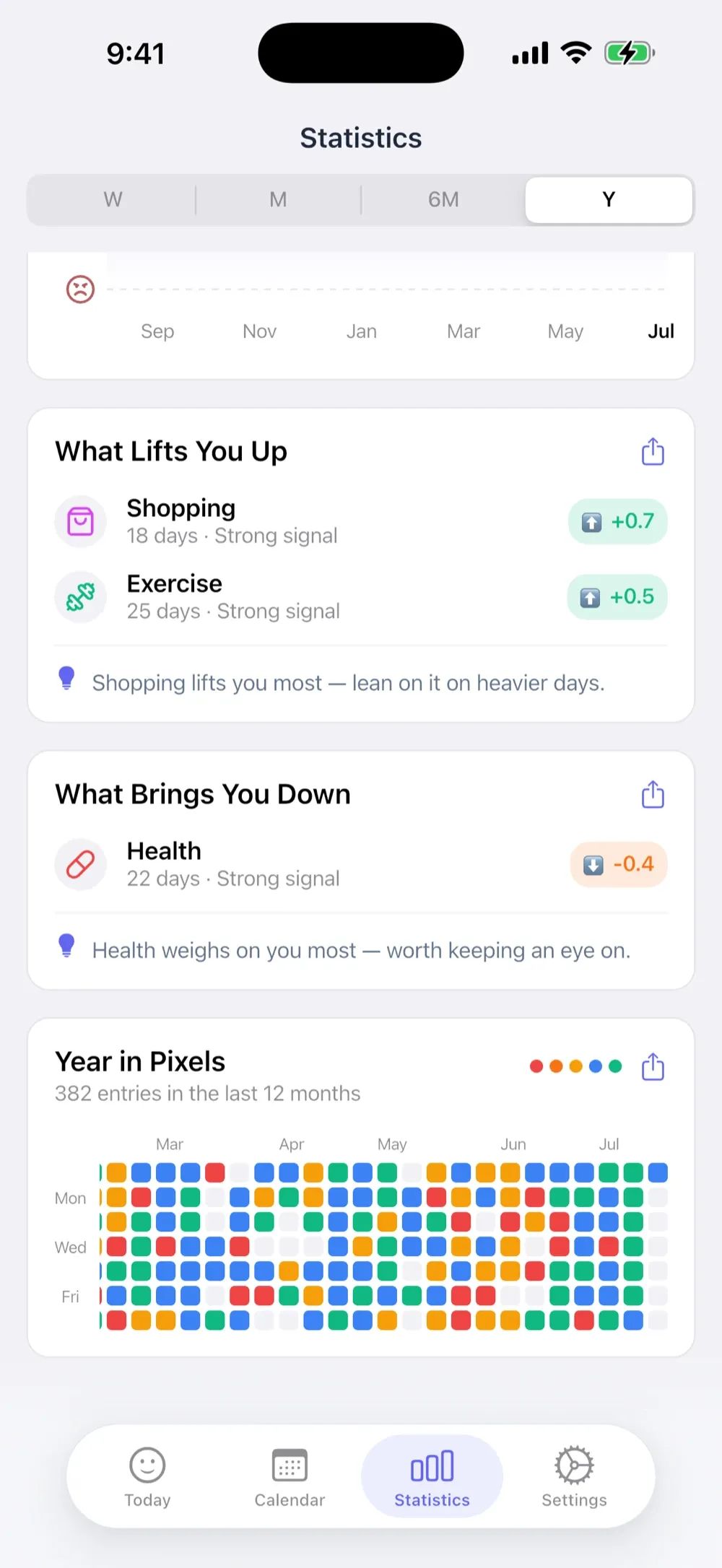
Monthly comparisons close the loop: once you’ve logged enough, MoodKit reports October against September in plain numbers, so “worse lately” becomes “down 0.6 for three weeks,” dated and checkable.
Decide your tripwire in advance
Here’s the step most guides skip, and in our opinion the most valuable one: while you feel fine, write down what reading would make you act. For example: if my two-week average drops a full point below the summer baseline and stays there, I book an appointment. Deciding the threshold now matters because the dip itself erodes the motivation to decide anything later.
Acting can mean a GP or therapist visit (bring the log; a dated mood record is exactly the history they’d otherwise reconstruct from memory), asking about light therapy, or the behavioral basics from the Mayo Clinic’s SAD guidance: protected morning light, kept-up exercise, guarded sleep times.
What tracking contributes is honesty in both directions. Some Novembers the grid will show you’re fine, just tired of early sunsets, and that’s a known limit of self-report worth respecting. And some Novembers it will show a real, persistent slide three weeks before you’d have admitted it to yourself. Both answers are worth fifteen seconds a day, but only if you start collecting while the leaves are still on the trees.
Frequently asked questions
When do seasonal mood changes usually start?
Many people notice the first slide in late September or October as daylight shortens, which is why starting a log in early September gives you the before-picture. Some feel changes earlier; a smaller group dips in summer instead.
Is a low mood in winter the same as seasonal affective disorder?
No. Lots of people get milder "winter blues." SAD is a clinical depression with a seasonal pattern: weeks of persistent low mood, oversleeping, carb cravings, and withdrawal that impair daily life. That distinction is a clinician's call, not an app's.
Can a mood tracker treat seasonal depression?
No, and be wary of any app implying it can. What tracking does well is evidence: it catches a drift early and hands you (or your doctor) a dated record instead of a vague "I've felt off lately."
Does light therapy work, and should I just buy a lamp?
Light therapy is a well-studied first-line treatment for SAD, but timing, brightness, and whether it fits your situation are worth a conversation with a professional first, especially if you have any history of bipolar disorder.
Keep reading
Year in Pixels, Explained: How to Read a Whole Year of Moods
What a Year in Pixels is, why one glance beats a hundred charts, how to read the patterns in your grid, and the easiest ways to keep one in 2026.
· 4 min read
How to Track Your Mood: The Complete 2026 Guide
A practical system for mood tracking that survives real life: picking a scale, tagging context, staying consistent, reading patterns, and testing changes.
· 5 min read
Does Mood Tracking Actually Work? What the Research Says
The honest evidence on mood tracking: what studies show it helps with, where the benefits stop, the illusory-correlation trap, and how to track so it works.
· 3 min read