Does Doomscrolling Wreck Your Mood? Run the One-Week Test
The MoodKit Team
· 3 min read
“Brain rot” went from meme to Oxford’s word of the year to, now, an actual research literature. A 2025 review of the evidence links compulsive negative-feed consumption with distress, anxiety, emotional desensitization, and worse sleep, and psychologists have been warning about the doomscrolling loop specifically for years: threat-scanning feels productive, delivers dread, and autoplays the next dread.
Here’s what the studies can’t tell you: whether your scrolling is costing you anything, and how much. Population correlations are made of other people. This is a rare case where n-of-1 evidence is genuinely better than the literature, because the intervention is free and the outcome is measurable on your own phone. So: measure it. (Disclosure: we build MoodKit, which runs the analysis and the experiment below natively. A notebook version works too, it’s just more chores.)
Phase 1: two weeks of tagged baseline
Log a 1-to-5 mood once or twice a day, per the usual method, and add one custom tag: doomscroll, applied to any entry where you’ve recently been in the pit. Definitions matter less than consistency; “twenty-plus minutes of feeds that left me worse” is a fine bar. Optionally add a news tag and a scrolled in bed tag, because those two turn out to be different crimes.
Don’t try to log minutes. Episode-level tagging is enough for the math, and minute-counting is its own little anxiety machine.
Phase 2: three reads on the data
After two weeks, interrogate the tags the same way you’d hunt any mood trigger:
- Same-day company. Do your low entries disproportionately carry the tag? MoodKit’s brings-you-down list and Impact Leaderboard put a measured number on this instead of a vibe.
- The morning-after bill. Compare each day’s mood with the previous evening’s tags. Scrolling’s sneakiest cost routes through sleep, and if a wearable writes sleep to Apple Health, MoodKit folds it in and its next-day analysis catches the lag directly. The sleep-and-mood guide covers that pathway in full.
- Context splits. Is “scrolled in bed” worse than daytime scrolling? Is the news tag the real culprit while memes are neutral? Specific verdicts beat blanket ones, because they demand smaller sacrifices.
Fair warning about direction: correlation here runs both ways, since bad days also cause scrolling (the review above frames it as a coping loop). Which is exactly why phase 3 exists.
Phase 3: the skip-week
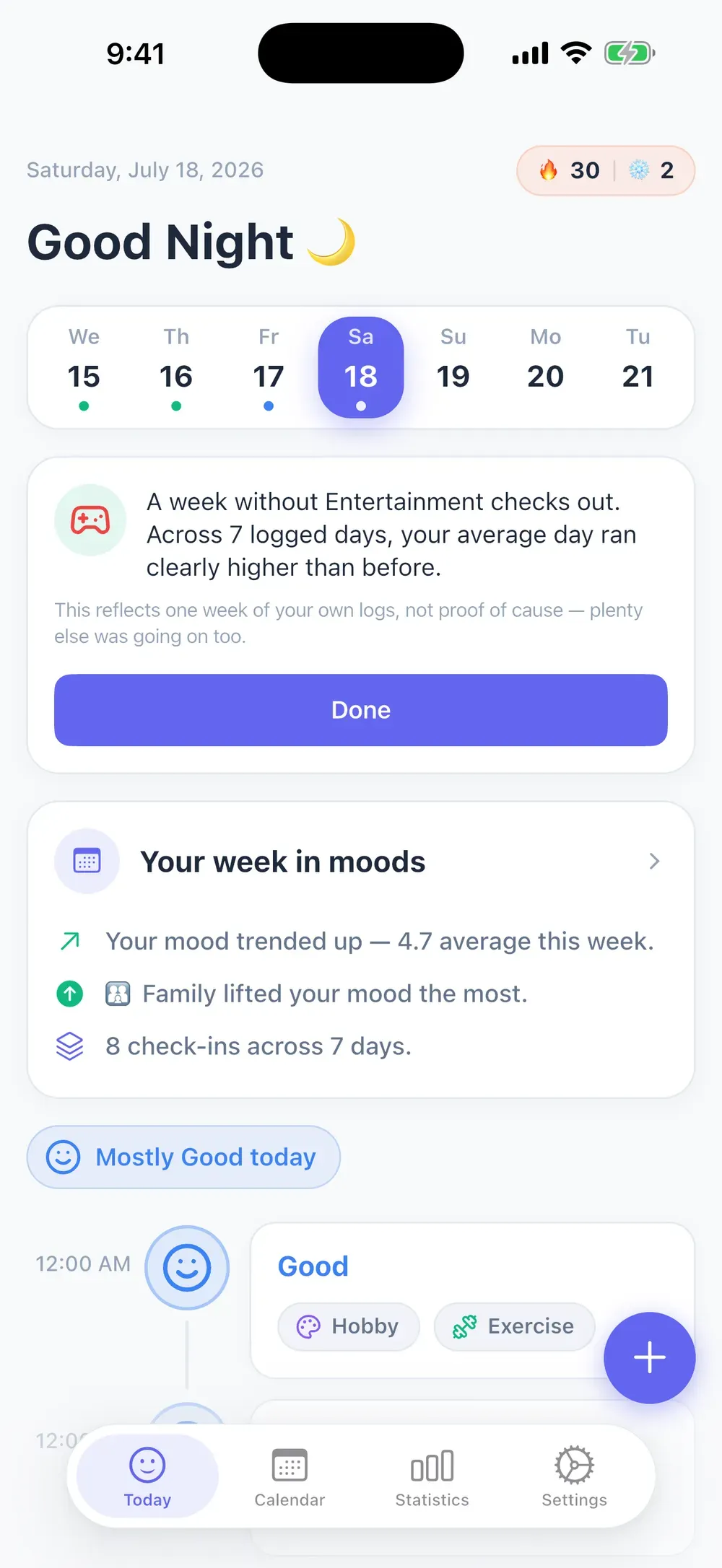
Causation needs an intervention: one week with the variable removed, everything else normal, moods compared against baseline. This is a textbook elimination experiment, and MoodKit has a native experiment type for precisely this (“skip a habit for a week to see if it was dragging you down”) that hands you a verdict from your own entries at the end.
Make the week survivable with mechanical help, because willpower alone loses to an algorithm every time: delete or log out of the worst app, set an app limit where the timer is the excuse, grayscale the phone, charge it outside the bedroom. If cold turkey is unrealistic, shrink the variable (no feeds before 9 am, or none in bed) and test that instead. A smaller true answer beats a grand abandoned one.
One measurement honesty note: MoodKit has no Screen Time integration, so the tag is manual and the skip-week runs on your own compliance. The verdict is only as good as the week you actually ran.
What people tend to find
From the research and from watching this experiment run: the biggest effects usually show up in sleep and next-morning mood rather than in the moment (the feed anesthetizes while it runs; the bill comes later), bedtime scrolling is the highest-yield single cut, and news-shaped scrolling costs more than social-shaped scrolling. But those are priors, not your answer. Some people run the skip-week and find nothing, and that’s a real result too: it means your gray evenings have a different cause, and your suspect list just got shorter.
Either way you exit the argument. A week of data closes a debate that a year of think-pieces, this one included, never will.
Frequently asked questions
Is doomscrolling actually bad for you, per research?
The correlational picture is consistent: heavy negative-feed consumption tracks with higher distress, worse sleep, and lower well-being. Individual effects vary a lot, which is precisely what a personal experiment sorts out.
How do I track doomscrolling without obsessing over screen time?
Don't log minutes, log episodes: one "doomscroll" tag on any mood entry where you've recently been in the pit. Your phone's Screen Time report can stay as backup evidence; the tag is enough for pattern analysis.
What if quitting for a week feels impossible?
That reaction is information, and the experiment still works in reduced form: cut one context (no scrolling in bed) or one time window (nothing before 9 am) and measure that instead. Smaller variable, same method.
Will one week really show anything?
For same-day and next-day effects, usually yes, especially against two weeks of baseline. Subtler effects need longer, but most people aren't chasing subtle; they're chasing "why are my evenings gray."
Keep reading
Self-Experiments: Test What Actually Lifts Your Mood
The n-of-1 method for mood: how to test one habit for one week and get an answer you can trust — including the traps that fool most self-experimenters.
· 4 min read
How to Find Your Mood Triggers (With Data, Not Guesswork)
A practical method for identifying what really sets off your bad days: build a suspect list, log context for two weeks, read the patterns, then test one change.
· 3 min read

Sleep and Mood: Stop Guessing, See It in Your Own Data
Fifty years of research says sleep loss drags mood down. Here's how to measure the effect in your own life with Apple Health and a two-week log.
· 3 min read