Sleep and Mood: Stop Guessing, See It in Your Own Data
The MoodKit Team
· 3 min read

Half the internet is currently optimizing sleep. One 2025 survey put 45% of Americans somewhere on the sleepmaxxing spectrum, taping mouths and chilling mattresses, and the wellness industry is delighted to sell the next upgrade. Meanwhile the actual science question, does better sleep improve my mood, specifically mine, goes unmeasured on most phones.
The general answer is settled. A 2024 meta-analysis in Psychological Bulletin pooled 154 experimental studies across five decades and found that shortened sleep, extended wakefulness, and fragmented nights all reliably blunt positive mood and push anxiety up. The American Psychological Association’s summary was blunt: sleep loss makes us less happy and more anxious.
But averages hide the part you can act on: dose and lag, for you. Some people shrug off a 5-hour night; some pay for it for two days. Here’s how to find your number. (Disclosure: we build MoodKit, which automates most of this; the manual version needs only a notebook and your phone’s sleep data.)
Get both signals flowing first
You need two streams for at least two weeks:
- Sleep. Anything that writes to Apple Health counts: an Apple Watch, an Oura or similar wearable, a bedside app, or Apple’s built-in bedtime schedule. Precision is overrated for this job; consistency isn’t.
- Mood. One to two quick check-ins a day, 1-to-5 scale, with activity tags. The full logging method is fifteen seconds a day, and the tags (caffeine, alcohol, late screen time) will matter in a minute.
In MoodKit, the connection is one switch: it reads last night’s sleep from Apple Health and treats it as a driver factor alongside your tags. It’s optional and off by default, and your health data stays on your device.
Read the lag, not just the day
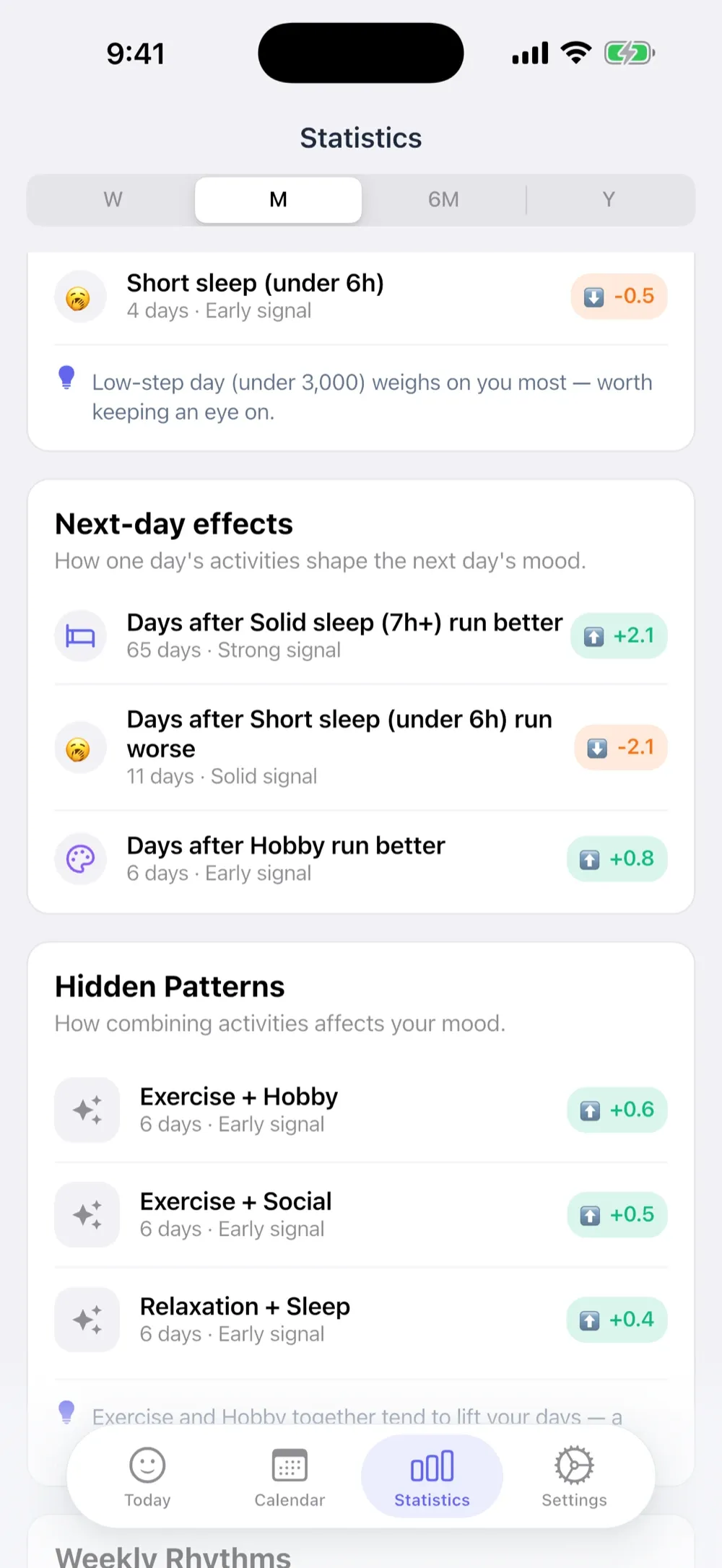
The classic mistake is comparing tonight’s sleep with tonight’s mood. Sleep’s bill arrives the next day, so line up each day’s mood against the previous night. Three patterns are worth hunting:
- Your threshold. Below what duration do your 2-out-of-5 days cluster? Common answers sit between 6 and 7 hours, but yours is an empirical question.
- The two-day shadow. Check whether a short night dents you the day after next, too. Plenty of people find the second day is the grumpy one.
- The saboteurs. Late caffeine, alcohol, and doom-scrolling in bed are famous sleep-wreckers; your tags let you see whether the mood damage routes through sleep (short night in between) or lands directly.
MoodKit’s next-day analysis does this alignment for you, and the Impact Leaderboard puts a measured number on each tag. If you’d rather squint at a spreadsheet, the trigger-hunting guide shows the manual reads.
One week, one variable, an answer
Correlation found, now confirm it. Pick a single change and hold it for a week:
- A fixed lights-out time (the highest-yield pick for most people).
- No caffeine after 2 pm.
- Phone out of the bedroom.
Keep everything else normal and compare the week against your baseline. This is exactly the shape of a mood self-experiment, and MoodKit runs it natively, including the “does a late night hurt tomorrow’s mood?” next-day variant, with a verdict computed from your own entries rather than from vibes.
Our genuine opinion, having watched a lot of this data: the boring fixed bedtime beats almost every gadget-shaped intervention people try first. Test it before you buy anything with a subscription.
When the data says “not sleep”
Sometimes the experiment comes back flat, and that’s a win too: you just saved yourself a winter of blaming the wrong thing, and you can go interrogate exercise, work stress, or whatever else your tags implicate. And a boundary worth restating: if sleep is chronically broken or your mood stays low regardless, that’s a conversation for a clinician. Self-tracking is for patterns, not diagnoses; here’s what the research says it can and can’t do.
Either way, the sleepmaxxing crowd has the order backwards. Measure first. Optimize second. It’s cheaper, and your mood log, not a marketing page, gets to say what worked.
Frequently asked questions
How much does one bad night actually affect mood?
The experimental literature is unusually consistent: even partial sleep loss reliably dampens positive mood (joy, energy, contentment) and raises anxiety the next day. The size varies by person, which is exactly why measuring your own response beats quoting averages.
Do I need a sleep tracker to do this?
No. Anything that gets sleep into Apple Health works: an Apple Watch, a third-party wearable, a bedside app, or Apple's own bedtime tracking. Rough consistency matters more than clinical precision here.
What's the fastest way to test if sleep is my problem?
Run a one-week bedtime experiment: pick a fixed lights-out time, keep everything else normal, and compare the week's moods against your baseline. Two weeks of casual logging beforehand gives you that baseline.
Can mood also affect sleep, not just the other way around?
Yes, the arrow points both ways: stressful days delay sleep, and short sleep sours the next day. That loop is worth seeing in your data, but persistent insomnia or low mood deserves a professional, not just an app.
Keep reading
Mood Tracking with Apple Health: State of Mind, Sleep & Steps
How Apple's State of Mind logging works, what it can't tell you, and how apps like MoodKit turn Health data — sleep, exercise, steps — into ranked mood factors.
· 5 min read
Self-Experiments: Test What Actually Lifts Your Mood
The n-of-1 method for mood: how to test one habit for one week and get an answer you can trust — including the traps that fool most self-experimenters.
· 4 min read
How to Find Your Mood Triggers (With Data, Not Guesswork)
A practical method for identifying what really sets off your bad days: build a suspect list, log context for two weeks, read the patterns, then test one change.
· 3 min read