Sober October Mood Tracking: What 31 Dry Days Do to Your Mood
The MoodKit Team
· 4 min read
Sober October has quietly become the new Dry January, and the official Go Sober for October challenge runs from October 1 to 31 this year. Most people finish it with a streak, a slightly smug glow, and a vague sense that they “felt better.” Vague is the part we’d like to fix.
A dry month is a natural experiment with a built-in before and after. If you log your mood through it, you leave with something a streak counter can’t give you: a number for what alcohol was doing to your Tuesdays. (Disclosure: we build MoodKit, which has experiments designed for this exact shape of question. Not medical advice, and one real warning: if you drink heavily every day, stopping abruptly can trigger withdrawal that needs supervision. The NIAAA’s guide to getting help is the place to start, before October.)
Get a baseline before October 1
The single biggest mistake is starting the log on the first dry day. Then all you have is October, and October compared with nothing is a vibe.
You have most of September. Log a mood once or twice a day, 1 to 5, with a tag for “alcohol” on the days you drink and whatever else is true (late night, social, exercise). That’s fifteen seconds an entry. By October 1 you’ll have three or four weeks of drinking-and-not-drinking days mixed together, which is exactly what the comparison needs.
What the research says you’ll notice
The best data on dry months comes from University of Sussex psychologist Richard de Visser’s studies of Dry January participants. By the end of the month, 56% reported better sleep and 52% more energy, and in a six-month follow-up of 1,192 participants the rise in self-efficacy, the feeling of being in control, was still there six months later. Around 72% were still drinking less at that point.
On the anxiety side, the Cleveland Clinic’s explainer on “hangxiety” describes the mechanism: alcohol boosts the brain’s calming signals while you drink, and overnight the system rebounds the other way. Nuffield Health cites estimates that roughly 12% of adult drinkers feel anxious during a hangover, with some studies putting it higher.
Notice the spread in those numbers. Half the participants slept better, which means half didn’t notice a difference. The population studies tell you what’s plausible. Your log tells you which half you’re in.
The three numbers to watch
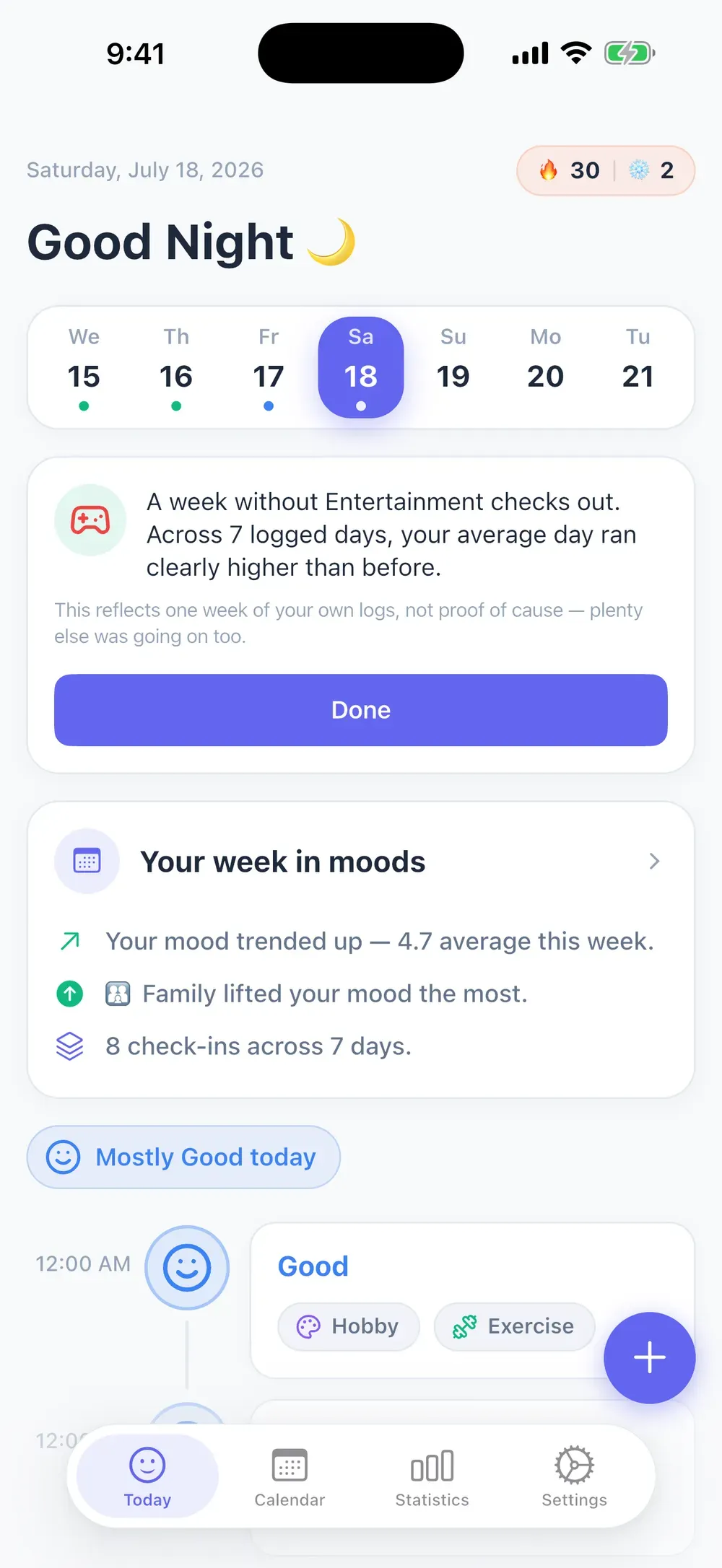
- Next-day mood. The question isn’t “how do I feel while drinking” but “how do I feel the morning after.” MoodKit’s next-day experiment exists for this: it measures whether a tagged evening changes tomorrow’s mood, the same way it can test whether a late night hurts the next day.
- Sleep length. If your phone or a wearable writes sleep to Apple Health, MoodKit ranks last night’s sleep alongside your tagged activities as a mood driver. Alcohol famously shortens and fragments sleep, so a chunk of its mood cost usually routes through the night in between.
- The weekend contrast. Weekly Rhythms shows how each weekday scores. If Saturday is your best day and Sunday your worst in September, and the gap closes in October, you’ve found where the drinks were hiding.
Tag the replacement, not just the absence
A dry month isn’t only removing something. Every evening that used to have a glass in it now has something else: a mocktail, a walk, an early night, a second episode. Tag those too. After a couple of weeks, the Impact Leaderboard ranks every tag by its measured effect on your mood, and you find out whether the lift came from the absence of alcohol or from the early night you replaced it with.
That distinction matters in November. For what it’s worth, when we ran this ourselves the elaborate mocktail measured as nothing and the early night carried the whole month. Your mileage will differ, which is the point.
What you’ll know on November 1
| Running Sober October on vibes | Running it with a log |
|---|---|
| ”I think I slept better” | Average sleep and mood, October vs September, side by side |
| ”Mornings felt easier” | Next-day mood on tagged evenings vs untagged ones |
| ”I’ll probably drink less now” | Which replacement activities actually carried the lift |
| Back to old habits by the 15th | A data-backed decision on what to keep |
November: the part nobody plans
The reason dry months fail to stick is that they end with willpower and no information. The Sussex follow-up is encouraging about self-control lasting, but you can do better than hope. Run November as a second experiment: a moderate week, then a skip-week where you drop alcohol again, and let MoodKit’s verdict tell you whether the difference is real for you. Keeping a habit because the data says it’s worth it beats keeping it because a calendar told you to.
Fair limits: MoodKit doesn’t count drinks or units (a tag is a tag, not a tally), there’s no Apple Watch app, and there’s no permanent free tier after the trial ($39.99 a year or $79.99 lifetime). For the question “what does drinking do to my mood,” though, a tag plus a next-day experiment is most of what you need.
Frequently asked questions
When does Sober October 2026 start?
The Go Sober for October challenge runs the whole month, from Thursday October 1 to Saturday October 31, 2026. Plenty of people run their own informal version on the same dates.
Does alcohol really affect your mood the next day?
For many people, yes. The morning-after anxiety nicknamed "hangxiety" is well documented: alcohol's calming effect wears off overnight and the brain rebounds the other way. How strong the effect is varies a lot between people, which is why your own log beats the averages.
Is it safe to stop drinking suddenly for a month?
For light and moderate drinkers, generally yes. If you drink heavily every day, stopping abruptly can cause withdrawal symptoms that need medical supervision. Talk to a doctor before October 1 in that case. This article isn't medical advice.
How many entries before MoodKit shows alcohol's effect?
Early patterns appear at 7 entries and root-cause analysis at 14, but the useful comparison needs both kinds of days in the log: several tagged with alcohol and several without. Start logging in September so October has a baseline to beat.
Keep reading

Sleep and Mood: Stop Guessing, See It in Your Own Data
Fifty years of research says sleep loss drags mood down. Here's how to measure the effect in your own life with Apple Health and a two-week log.
· 3 min read
Self-Experiments: Test What Actually Lifts Your Mood
The n-of-1 method for mood: how to test one habit for one week and get an answer you can trust — including the traps that fool most self-experimenters.
· 4 min read
How to Find Your Mood Triggers (With Data, Not Guesswork)
A practical method for identifying what really sets off your bad days: build a suspect list, log context for two weeks, read the patterns, then test one change.
· 3 min read