How to Track Burnout Before It Tracks You: A 30-Day Method
The MoodKit Team
· 5 min read

Burnout is an occupational phenomenon, not a diagnosis, and this article isn’t medical advice. If low mood follows you out of work and lasts weeks, see a clinician.
Nobody wakes up burned out. It’s assembled over months, in increments small enough to adapt to, which is precisely why people don’t notice until a Tuesday in autumn when they can’t make themselves open the laptop. Mental Health UK’s Burnout Report 2026, a YouGov poll of 4,502 UK adults, found 91% had felt high or extreme stress in the past year and one in five workers had taken sick leave for stress-related mental health, rising to two in five among 18-to-24-year-olds. The top workplace causes were workload (42%), unpaid overtime (33%), and job insecurity (32%). Off the clock, the biggest factor was poor sleep, at 59%.
The WHO defines burnout by three things: exhaustion, growing mental distance from your job, and reduced effectiveness. All three are trends, and trends are what a daily log is for. (Disclosure: we build MoodKit, which is a mood tracker and not a burnout inventory. It’s the logging tool in the method below, with its limits noted.)
Burnout is a slope, not a switch
The reason burnout ambushes people is adaptation. Each week’s slightly worse baseline becomes the new normal, and you lose the memory of the old one. Ask someone in month four how they felt in month one and they’ll guess, badly.
A log doesn’t adapt. It remembers that your average was a 3.8 in June and is a 2.9 now, and it remembers whether weekends used to lift you. September, when the return from summer meets the year’s heaviest quarter, is a sensible time to start one.
The 30-day method
- Two check-ins a day. One mid-workday, one in the evening. A 1-to-5 mood and tags; the whole routine is about fifteen seconds. Two entries matter here because burnout shows up as a gap between how work feels and how the evening feels, and one entry a day can’t see the gap.
- Tags that describe the load. Work, overtime, meetings, commute, and then the recovery side: exercise, friends, outdoors, hobby. Add “worked late” and “checked email in bed” as their own tags; they’ll matter in week three.
- Two custom moods. “Flat” and “wired” both score as a 2 on a plain scale and mean different things. Naming them separately is the cheapest upgrade in this whole method.
- Notes only for events. A note is for “manager moved the deadline,” not a diary. Save your energy for the check-ins.
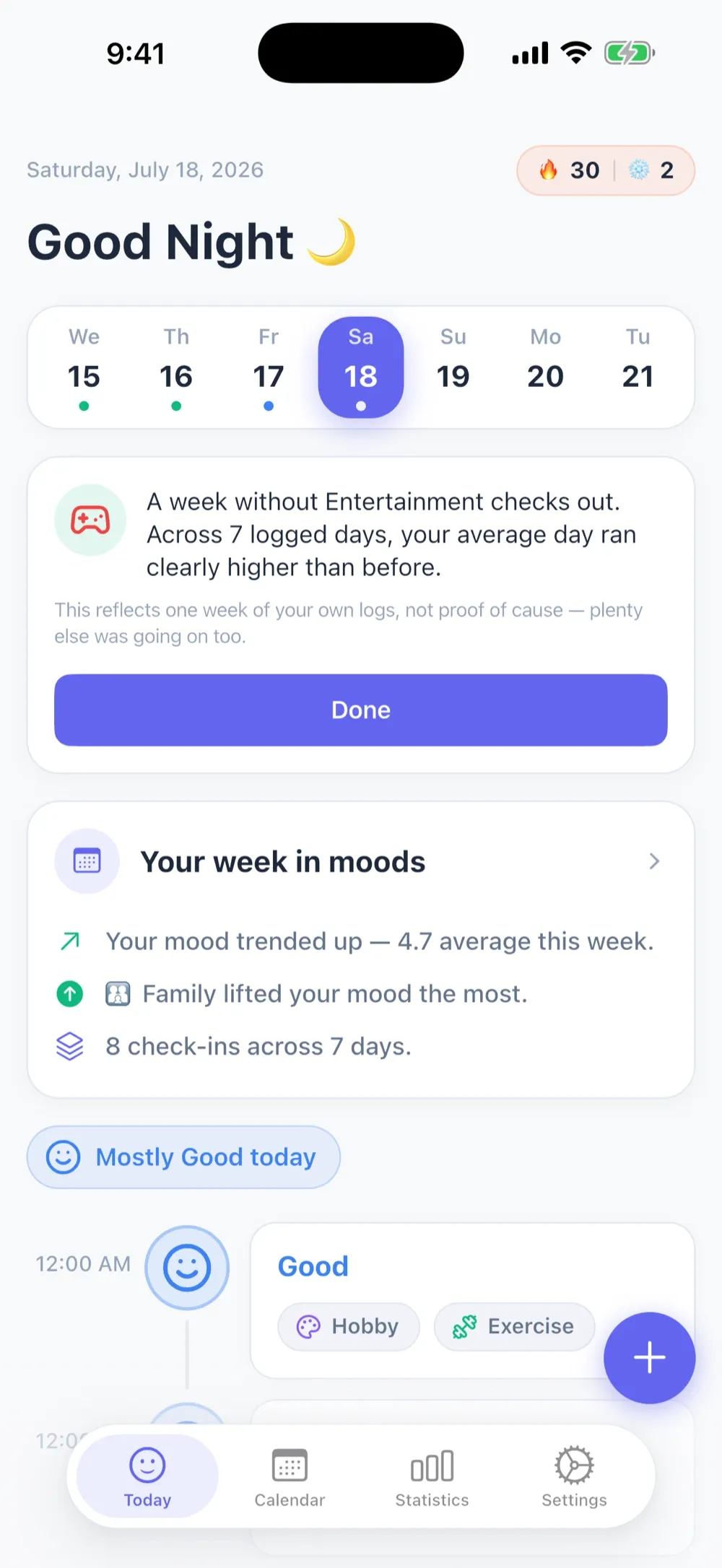
MoodKit’s insight tiers map onto the month neatly: weekday patterns after 7 entries, root causes after 14, and a monthly comparison after 30. The comparison is the number you’re building toward.
Three signals in the data
| Signal | What the log shows | What it means |
|---|---|---|
| The recovery gap closes | Weekend scores drift down to match weekdays; Weekly Rhythms flattens | Time off has stopped refilling you, the earliest warning there is |
| The lifts stop lifting | Exercise, friends, or your hobby slide down the Impact Leaderboard | Exhaustion is blunting the things that used to work |
| The baseline drifts | Monthly comparison lower two months running, with no obvious event | The slope itself, now visible |
Any one of these is a reason to change something. Two together is a reason to change something this month. The guide to identifying triggers covers how to read the tag-level detail, but the burnout-specific reading is simpler: it’s rarely one trigger. It’s the recovery side of the ledger going quiet.
What to change first, and how to know it worked
Start with sleep, because the report’s respondents did: poor sleep was the top non-work stressor at 59%, and a short night makes every workday tag look worse than it is. If a phone or wearable writes sleep to Apple Health, MoodKit ranks last night’s sleep against your activities so you can see how much of the damage is routing through it.
Then run one change at a time as a one-week experiment. The two with the best track record in our own logs: a skip-week on evening email (drop it entirely for seven days and let the skip-a-habit experiment deliver a verdict), and a try-a-habit week where one recovery activity, the walk or the call with a friend, happens daily without negotiation. The point of the experiment format is that it’s allowed to fail. If the email ban does nothing, you’ve learned the problem is bigger than your inbox.
When tracking is no longer the answer
A log is a mirror, not a treatment. If your score is low most days for two weeks or more, if the weekend and a week off don’t move it, or if you have any thoughts of harming yourself, the next step is a doctor, a therapist, or occupational health, and in the US you can call or text 988. The report found only 27% of workers believe their employer genuinely prioritizes mental health, which is a reason to bring evidence to the conversation rather than a reason to skip it. Bringing your log to therapy covers how to present it; the Sunday scaries piece is the lighter cousin of this article, for when the dread is still confined to one evening a week.
MoodKit’s limits, so nobody’s surprised: it doesn’t track hours worked, it has no burnout questionnaire or symptom scales, there’s no Apple Watch app, and there’s no permanent free tier after the trial ($39.99 a year or $79.99 lifetime). What it does is remember, rank, and compare, which is exactly the part of burnout your own brain is worst at.
Frequently asked questions
Is burnout a medical condition?
The World Health Organization classifies burnout as an occupational phenomenon, not a medical condition: chronic workplace stress that hasn't been managed, with exhaustion, mental distance from the job, and reduced effectiveness. Its symptoms overlap with depression, which is a medical condition, so persistent lows deserve a clinician.
What's the difference between burnout and depression?
Burnout is tied to work and tends to lift when the work stops. Depression follows you into the weekend and the holiday. A mood log makes that distinction visible: if time off doesn't move your score, talk to a professional rather than tweaking your calendar.
How long do I need to track to spot burnout?
Thirty days is a good first window because it includes four weekends and a full monthly comparison. Burnout is a slow trend, so the second and third months, compared against the first, are where it shows.
Can a mood tracker prevent burnout?
It can't change your workload. What it does is defeat the slow adaptation that hides burnout from you, by remembering how you felt six weeks ago when you can't. Catching the slope early is what gives the fixes a chance.
Keep reading

Sunday Scaries: Track Them for Two Weeks and Watch Them Shrink
Most workers dread Sunday night. Two weeks of fifteen-second check-ins show whether your scaries are about Monday, about sleep, or about the weekend itself.
· 5 min read
How to Track Your Mood: The Complete 2026 Guide
A practical system for mood tracking that survives real life: picking a scale, tagging context, staying consistent, reading patterns, and testing changes.
· 5 min read

How to Find Your Mood Triggers (With Data, Not Guesswork)
A practical method for identifying what really sets off your bad days: build a suspect list, log context for two weeks, read the patterns, then test one change.
· 3 min read