Nature and Mood: Test the 20-Minute 'Nature Pill' on Yourself

The MoodKit Team
· 5 min read

The leaves are about to turn, which makes this the easiest month of the year to run the experiment in this article. The evidence behind it got a lot stronger in 2025, when a team led from Stanford and Harvard published a meta-analysis in Nature Cities that reviewed 449 studies and pooled 78 field experiments, and found that brief exposure to urban nature improves a broad range of mental-health outcomes, most strongly in young adults. Doctors are catching on: Medscape ran a 2026 piece on when to prescribe nature, and “green prescriptions” are now a thing GPs write.
The dose question has answers too, at least on average. A 2019 study measuring cortisol found that 20 to 30 minutes in a natural setting gave the biggest drop per minute, and a UK survey of around 20,000 people put the weekly threshold for reporting better wellbeing at roughly two hours. Those are averages. What we’re interested in is your number. (Disclosure: we build MoodKit, which is the tracker used below and which, fair warning, has no location or weather features. Not medical advice.)
The dose question the research can’t answer for you
“Twenty minutes” is the mean of a distribution. Some people get their full lift from a ten-minute walk past street trees; others need an hour by water before anything shifts. The mechanism the researchers lean on, attention restoration through “soft fascination,” the effortless kind of noticing that lets an overworked prefrontal cortex recover, plausibly varies with how depleted you are that day and how much you actually look at the trees.
So treat the studies as a strong prior and your log as the update. The good news is that green time is one of the cheapest experiments in mood tracking: it costs nothing and it’s already in most people’s week somewhere.
Tag it three ways
The mistake is one tag called “outdoors.” It bundles three different things: movement, daylight, and greenness. Split them.
- Walk for any walking, wherever it happened. (Movement has its own evidence; the steps and mood guide covers it.)
- Green for time in a park, woods, garden, or anywhere the view is mostly plants, whether or not you moved.
- Daylight for time outside in the day, including the grey concrete kind.
A park walk at noon gets all three tags; a treadmill gets none; sitting on a bench under a tree gets two. After a couple of weeks of fifteen-second check-ins, MoodKit’s Impact Leaderboard ranks each tag by its measured effect on your mood, with the day counts shown, and you can see whether “green” pulls its weight on top of walking and daylight or just rides along with them.
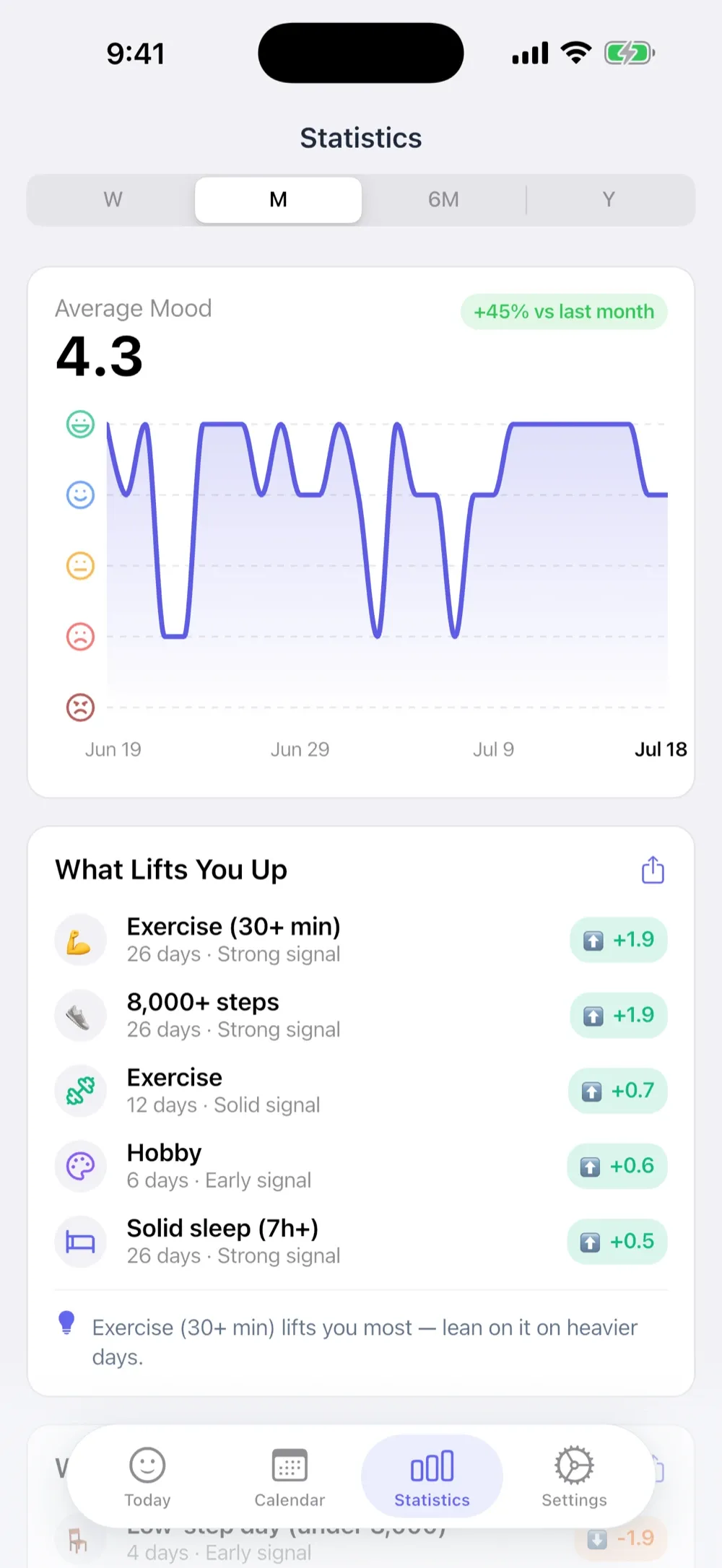
Hidden Patterns is worth watching here too. “Green plus friend” outperforming either alone is a common finding, and the kind of thing nobody would think to test.
One week of twenty minutes
Once the tags have a baseline behind them, run the actual test as a one-week self-experiment: twenty minutes of green time every day for seven days, logged as usual. MoodKit runs this as a try-a-habit week and compares the week against your baseline, then gives a verdict computed from your own entries.
Two refinements that make the result more useful:
- Fix the time of day. Morning green time also delivers morning light, which matters more as the days shorten. If you can, keep it consistent for the week so you’re testing one thing.
- Tag the quality. The research on how you engage found that people who deliberately noticed trees and plants reported bigger mood gains than people who walked the same route looking at buildings. A “noticed” tag, or a two-word note, lets you check whether that holds for you.
| Study | Setting | Dose | Finding |
|---|---|---|---|
| Nature Cities meta-analysis (2025; 78 experiments) | Urban nature: parks, street trees, urban forest | Brief, single exposures | Improved mood and anxiety outcomes across nature types; strongest in young adults |
| Cortisol “nature pill” study (2019) | Any place that felt natural to the participant | 10+ minutes, 3× a week | 20–30 minutes gave the most efficient cortisol drop |
| UK wellbeing survey (2019; ~20,000 people) | Any nature contact | Weekly total | Better self-reported wellbeing from about 120 minutes a week |
Facts checked September 2026.
Reading a null result
Sometimes the verdict is “no effect,” and there are three boring reasons before you conclude nature does nothing for you. You may already get enough green time that adding more doesn’t register. The week may have been unusual (a work crisis will flatten any twenty-minute habit). Or the effect may be real but small, and a 1-to-5 scale over seven days is too coarse to catch it; running a second week, or a skip-week where you cut green time entirely, often resolves it. And if it really is nothing, keep walking anyway. The cardiovascular case doesn’t need your mood’s permission.
Limits, plainly: MoodKit doesn’t know where you are or what the weather did, so every tag in this article is one you add yourself; there’s no Apple Watch app; and there’s no permanent free tier after the trial ($39.99 a year or $79.99 lifetime). For the question “how much green do I need,” a tag, a leaderboard, and a one-week test are the whole kit.
Frequently asked questions
How much time in nature improves mood?
The research points at surprisingly small doses. A 2019 study found 20 to 30 minutes in a natural setting gave the most efficient drop in the stress hormone cortisol, and a large UK survey found benefits from around two hours a week in total. Your own threshold may differ, which is what tracking is for.
Does it have to be a forest, or does a city park count?
City parks count. The 2025 meta-analysis in Nature Cities looked specifically at urban nature, including parks, street trees, and urban forests, and found consistent mental-health benefits across them, with the strongest effects in young adults.
Does MoodKit track my location or the weather?
No. MoodKit has no location or weather features, so time outdoors is a tag you add to a check-in yourself. It does read steps from Apple Health, which helps separate the walking from the green.
What if I live somewhere with little green space?
The research includes street trees, small parks, and waterfronts, and some benefit shows up even for views of greenery. Tag whatever version of nature you can reach and let the data tell you whether it's enough to register.
Keep reading

Steps and Mood: What 7,000 a Day Does, and How to Check Yours
Two large meta-analyses tie 7,000 daily steps to fewer depressive symptoms. Here's how to see whether steps actually move your own mood, using Apple Health.
· 4 min read

Self-Experiments: Test What Actually Lifts Your Mood
The n-of-1 method for mood: how to test one habit for one week and get an answer you can trust — including the traps that fool most self-experimenters.
· 4 min read

Autumn Mood Dips: Build Your Seasonal Baseline Now
Days are shortening and September moods are already sliding. How to track a seasonal pattern properly, when the data means something, and when to get help.
· 3 min read