Steps and Mood: What 7,000 a Day Does, and How to Check Yours
The MoodKit Team
· 4 min read

The 10,000-step target has been quietly retired. In July 2025 a meta-analysis in The Lancet Public Health pooled 57 studies and found most health benefits level off around 7,000 steps a day, including a roughly 22% reduction in depressive symptoms compared with 2,000. Seven months earlier, a JAMA Network Open review of 33 studies covering about 96,000 adults reported that people logging 7,000 or more steps had a 31% lower risk of depression, and that each extra 1,000 steps a day was linked to a 9% lower risk.
Those are good numbers. They are also averages over tens of thousands of strangers, and the question you actually have is narrower: do my steps move my mood? (Disclosure: we build MoodKit, which reads steps from Apple Health and ranks them against your mood, so it’s the tool in the second half. Not medical advice.)
Why the population number can’t be your number
Two problems hide inside “7,000 steps lowers depression risk.”
The first is direction. Nearly all of the pooled studies are observational. People with low mood walk less, so some of the association runs from mood to steps, not the other way. The JAMA authors say as much. The second is variation. A 22% average reduction is made up of people for whom walking is a lifeline and people for whom it does nothing, and the average tells you nothing about which group you’re in.
Neither problem is fatal. They just mean the studies give you a hypothesis, and you have to run the test yourself. Happily, your phone has been collecting half the data for years.
Turn your step count into a mood driver
The iPhone already writes a daily step count to Apple Health, with no watch required. What’s missing is the other half: a mood score to line it up against.
MoodKit’s Apple Health integration does the lining up. Once you turn it on (it’s optional and off by default, and the health data stays on your device), your sleep, exercise, and steps are ranked alongside the activities you tag, so “steps” competes on the same leaderboard as “friends” or “late night” for the title of what actually drives your mood. The full setup guide covers permissions; the short version is one toggle.
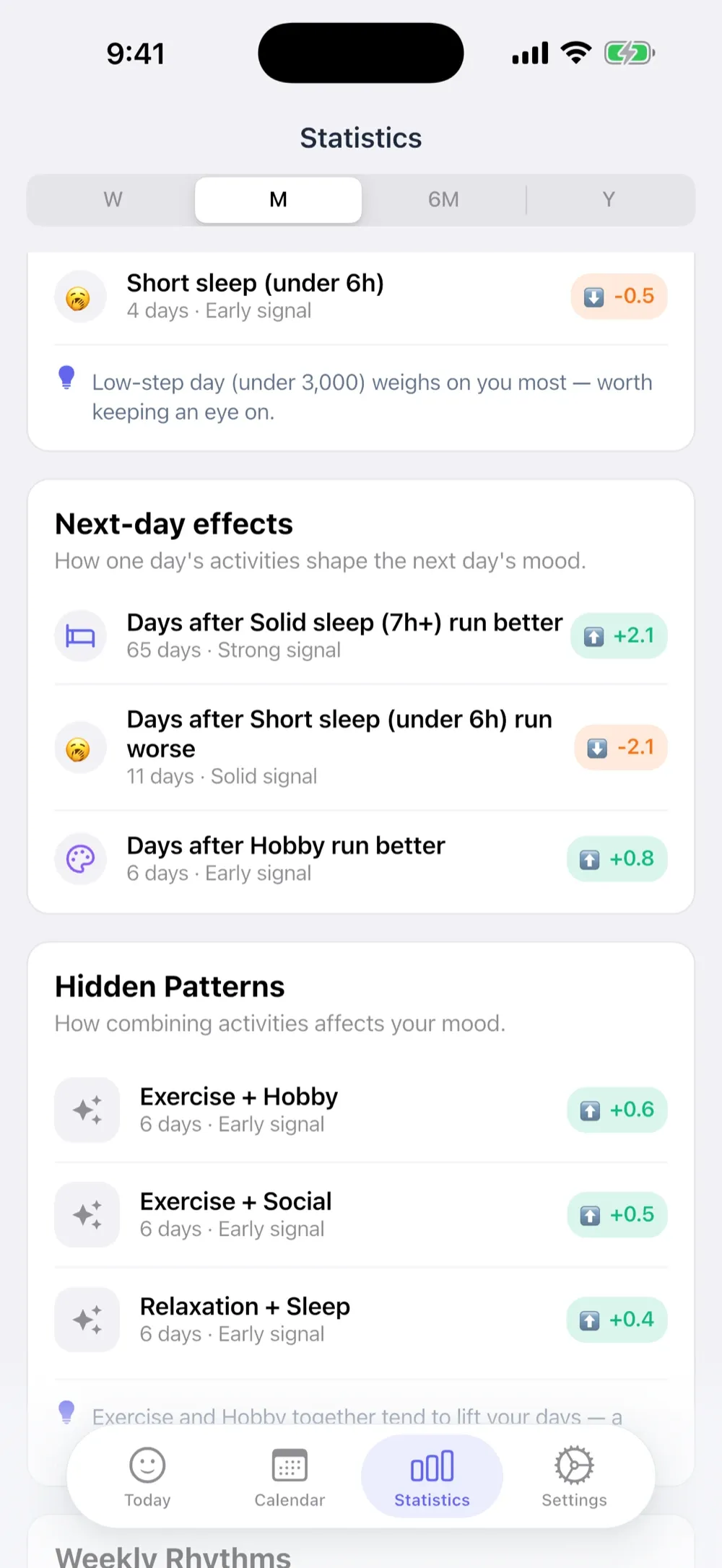
Your side of the bargain is the mood score: one or two fifteen-second check-ins a day, 1 to 5, with tags. Do that for a few weeks and you have a personal version of the meta-analysis with a sample size of one, which for this question is the only sample size that matters.
Reading the result without fooling yourself
Three outcomes are likely, and each means something different:
- Steps and mood rise together on the same day. Real, but ambiguous. Good days might make you walk, or walks might make good days. Treat it as a lead, not a verdict.
- Yesterday’s steps predict today’s mood. Stronger. Mood can’t reach backwards and cause yesterday’s walk. MoodKit’s next-day experiment is the clean way to test this: it checks whether a tagged day changes tomorrow’s score.
- No relationship at all. Also information. It means walking is doing its work on your heart and joints without touching your mood much, and you should look elsewhere for mood levers. The guide to what mood tracking can and can’t prove is worth a read before you over-interpret any of the three.
| Study | What it measured | What it found | What it can’t tell you |
|---|---|---|---|
| Lancet Public Health, July 2025 (57 studies) | Steps vs 9 health outcomes | Benefits plateau near 7,000; depressive symptoms ~22% lower vs 2,000 | Whether walking causes the mood change in you |
| JAMA Network Open, Dec 2024 (33 studies, ~96k adults) | Steps vs depression | 7,000+ steps: 31% lower risk; +1,000 steps: 9% lower | Which direction the link runs |
| Your log, next month | Your steps vs your mood | Whatever is true for you | Whether it generalizes (it doesn’t need to) |
Facts checked September 2026.
A one-week walking experiment
Correlation gets you a suspect. A one-week self-experiment gets you a verdict. Pick a target you can hit on a bad day, not a heroic one: 2,000 steps above your current average, or a fixed 20-minute walk, is plenty. Do it daily for seven days, keep logging, and compare against the baseline weeks. MoodKit runs this as a try-a-habit experiment and reports whether the difference cleared its noise floor, and it will tell you “no effect” if that’s what your numbers say.
Two refinements once the basic test is done. Tag where you walked, because the mood effect of a park loop and a car-park loop may not be the same thing, and green time appears to carry its own lift. And tag when, since a morning walk also delivers daylight, which matters more as the days shorten.
Limits worth knowing: MoodKit has no step goals or coaching, no Apple Watch app (steps arrive via Health from your phone or any wearable), and no permanent free tier after the trial ($39.99 a year or $79.99 lifetime). It answers one question well: whether the walking is working.
Frequently asked questions
How many steps a day improve mood?
In the 2025 Lancet Public Health meta-analysis, depressive symptoms were about 22% lower at 7,000 steps a day than at 2,000, and a 2024 JAMA Network Open analysis found 7,000 or more steps linked to a 31% lower risk of depression. Both are population averages; your own number may sit above or below them.
Does walking help with anxiety too?
Regular physical activity is broadly linked to lower anxiety, but the step-count studies focused on depressive symptoms. If anxiety is your target, track it as its own custom mood so you can see whether walking days differ.
Do I need an Apple Watch to track steps against mood?
No. The iPhone counts steps on its own and writes them to Apple Health. Any watch or band that syncs to Health works as well. MoodKit reads steps from Health; it has no watch app of its own.
How long before a steps pattern shows up in MoodKit?
Early patterns appear after seven entries and deeper analysis after fourteen. For steps specifically, two to three weeks with a mix of low-step and high-step days is a sensible minimum.
Keep reading

Mood Tracking with Apple Health: State of Mind, Sleep & Steps
How Apple's State of Mind logging works, what it can't tell you, and how apps like MoodKit turn Health data — sleep, exercise, steps — into ranked mood factors.
· 5 min read

Sleep and Mood: Stop Guessing, See It in Your Own Data
Fifty years of research says sleep loss drags mood down. Here's how to measure the effect in your own life with Apple Health and a two-week log.
· 3 min read

Self-Experiments: Test What Actually Lifts Your Mood
The n-of-1 method for mood: how to test one habit for one week and get an answer you can trust — including the traps that fool most self-experimenters.
· 4 min read