Mood Tracking for Therapy: Turn Your Log Into Better Sessions
The MoodKit Team
· 5 min read

MoodKit is a mood tracker, not a clinical tool, and this article isn’t medical advice. It’s about getting more out of therapy you’re already in.
“So, how was your week?” It’s the question every session opens with, and if you’re like most people you answer it from the last 48 hours, because that’s what memory serves up. The Tuesday you couldn’t get out of bed and the Thursday that was unexpectedly good have both evaporated. Fifty minutes, at a price that pushes many people out of care altogether, and the first ten go to reconstructing a week you were there for.
Therapists know this, which is why mood charts are a staple of practice; SimplePractice’s daily mood chart guidance asks for daily ratings plus the events and people around them, and the case for mood charts in therapy is that they turn recall into evidence. World Mental Health Day on October 10 has “Lived Experience Heard” as this year’s theme; a log is your lived experience, written down while it was happening. (Disclosure: we build MoodKit, which is used for the logging in this guide. It has no therapist portal and no clinical questionnaires, which we’ll come back to.)
What therapists actually want from a log
Not a diary. Four things, and briefly:
- Frequency and intensity. How often the lows came and how low they went. A 1-to-5 scale does this fine; the scale matters less than using the same one every day.
- Context. What was happening. Who you were with, whether you slept, whether you drank, whether it was a workday. Tags cover this without writing a paragraph.
- Timing. Time of day and day of week, because “always Sunday evening” and “always after the 4 p.m. meeting” point at different work.
- Homework. Whether you did the thing you agreed to do, and what happened when you did.
Anything beyond that is a bonus your therapist may or may not want. Ask.
A log that survives a bad week
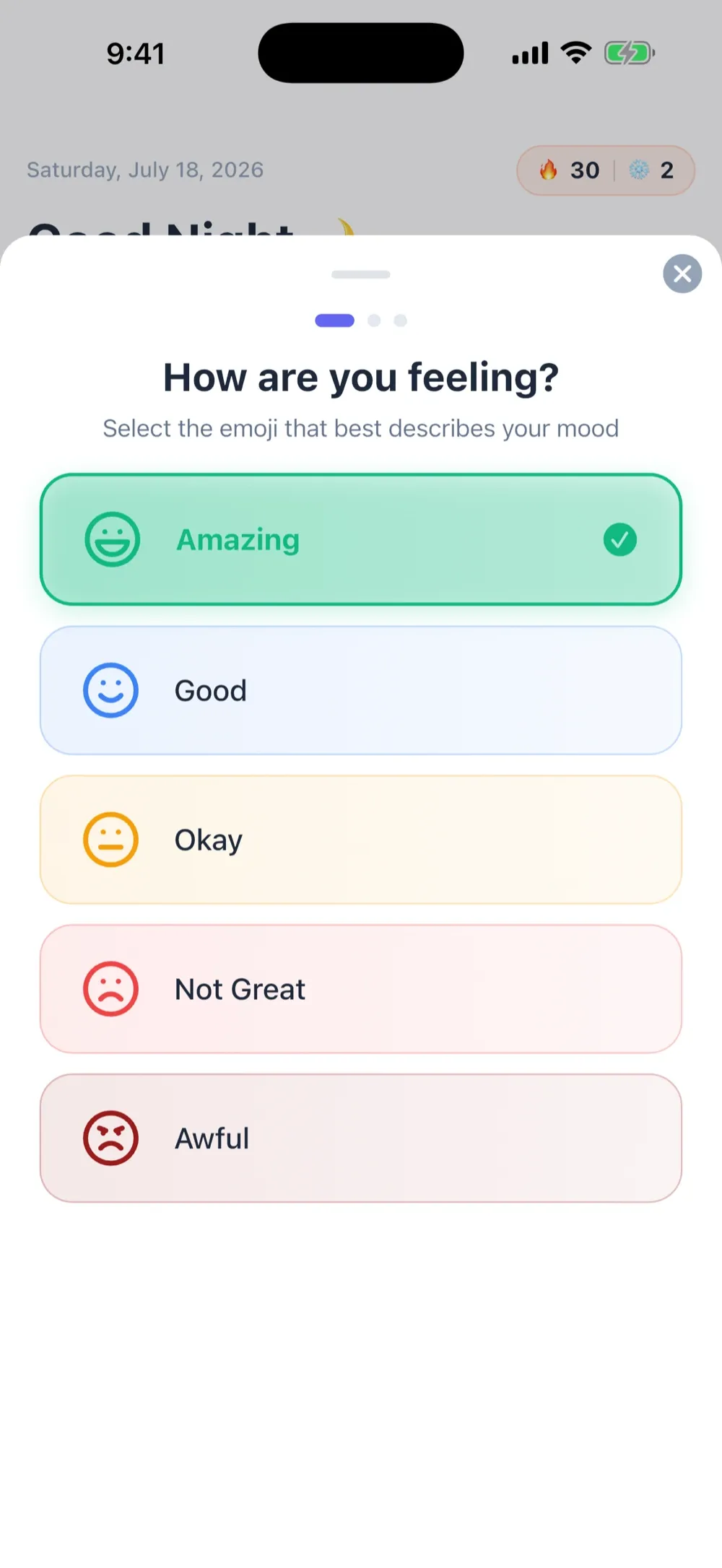
The best mood log for therapy is the one still being kept in the week you most needed it, which rules out anything effortful. The routine we recommend is fifteen seconds: a mood, a few tags, done. Notes only when something happened. MoodKit’s reminders carry a custom label, so the prompt can say “session prep” or “did the walk?” instead of “log your mood,” and a check-in can be answered from the notification without opening the app.
If you and your therapist are working on naming feelings more precisely, custom moods are the tool: “anxious,” “numb,” and “irritable” as their own entries rather than three flavors of a 2. The feelings wheel guide walks through building that vocabulary.
The five-minute pre-session review
The night before, open the last two weeks and write three bullets:
- The two lowest days, with the tags that were on them.
- The highest day, with the same.
- One pattern you think you see, even if you’re not sure.
MoodKit’s calendar colors each day by mood, the timeline lists every entry, and filters narrow the calendar down to the days you want to talk about. After thirty entries the monthly snapshot summarizes the month, and Weekly Rhythms shows which days of the week run low. The three bullets are what you say out loud; the screens are what you show if asked.
Sharing: CSV, screenshot, or just talk
| Method | Good for | Watch out for |
|---|---|---|
| Talk from three bullets | Every session; keeps you in charge of the story | Easy to skip the days you’d rather not discuss |
| Calendar screenshot | A month at a glance, in ten seconds | Colors need a one-line legend |
| CSV export | Therapists who chart, or long gaps between sessions | Contains your notes; check what you’re sending |
MoodKit exports CSV and takes a full JSON backup, and both are yours to send or not. There’s no therapist portal, no shared account, and no server holding your entries; mood data stays on your device unless you export it or use your own iCloud sync. That’s the whole privacy model, and for therapy data it’s the one we’d want. The private tracker round-up compares how other apps handle the same question.
Homework as experiments
A lot of therapy homework is a hypothesis: “walk every morning this week and see if it helps,” “try the breathing exercise when the anxiety starts,” “no phone after ten.” Those are one-week self-experiments, and MoodKit runs them natively: pick the habit, do it daily for seven days, get a verdict computed from your own entries against your baseline. Bring the verdict to the session. “It helped” and “it measured as a 0.4-point lift over the week” are different conversations, and the second one lets you and your therapist decide what to keep. The verdict is allowed to be “no effect”; that’s homework too.
Limits, plainly: MoodKit has no PHQ-9 or GAD-7 (Apple’s Health app has both on iOS 17 and up, and therapists often administer them directly), no way to share live with a clinician, no photos, and no permanent free tier after the trial ($39.99 a year or $79.99 lifetime). It won’t do the therapy. It will make sure the week arrives at the session intact.
Frequently asked questions
Should I show my therapist my mood tracker?
Usually, yes, and most therapists welcome it. Mood charts are a standard tool in practice, and a log turns vague recall into specific days and contexts. Ask your therapist how they'd like to see it; some prefer a two-minute summary, others want the chart.
What's the best format to share a mood log?
A screenshot of the month's calendar or a short CSV export covers most sessions. The most useful thing is often three bullets you write yourself: the two lowest days with what was happening, the highest day, and one pattern you noticed.
Does MoodKit include PHQ-9 or GAD-7 questionnaires?
No. MoodKit tracks mood, activities, and Apple Health sleep, exercise, and steps; it isn't a clinical instrument. Apple's Health app offers the PHQ-9 and GAD-7 on iOS 17 and later, and your therapist may administer them directly.
Is my mood data private if I use an app?
It depends on the app. In MoodKit, mood entries never leave the device unless you export them or turn on your own iCloud sync; there is no account and no MoodKit server. Analytics covers app usage and crashes only, never how you feel.
Keep reading
How to Track Your Mood: The Complete 2026 Guide
A practical system for mood tracking that survives real life: picking a scale, tagging context, staying consistent, reading patterns, and testing changes.
· 5 min read
The Feelings Wheel: Precision Beats 'Fine' (Here's How)
How to actually use an emotion wheel: the science of naming feelings, a 30-second daily practice, and wiring your new vocabulary into a mood tracker.
· 3 min read
Does Mood Tracking Actually Work? What the Research Says
The honest evidence on mood tracking: what studies show it helps with, where the benefits stop, the illusory-correlation trap, and how to track so it works.
· 3 min read