Sunday Scaries: Track Them for Two Weeks and Watch Them Shrink
The MoodKit Team
· 5 min read
It’s 6 p.m. on Sunday. The weekend isn’t over, nothing bad has happened, and your stomach has already clocked in for Monday. When LinkedIn asked 3,000 US workers about this feeling, 80% said they get it, and workload was the top reason. The Cleveland Clinic files it under anticipatory anxiety: the stress of the week arriving a day early.
Most advice stops at “plan your Monday and put the phone down.” That’s fine, but it assumes every Sunday low is the same Sunday low, and it isn’t. (Disclosure: we build MoodKit, a mood tracker whose weekday view is built for exactly this question, so it shows up in the method below. This isn’t medical advice; if the dread is with you most days, not just Sundays, talk to a professional.)
Three different Sundays that feel identical
From the inside, the Sunday scaries are one feeling. From the data, they’re usually one of three:
- Monday dread. The low is about the week ahead: the inbox, the meeting, the person. Mood dips Sunday evening and often lifts by Monday lunch, once the imagined week becomes the real one.
- Weekend hangover. Not always the alcohol kind. A late Saturday, a lie-in that wrecks Sunday’s sleep, or two days of screens leave you flat on Sunday, and the flatness gets blamed on Monday because Monday is what’s in view.
- The empty weekend. You did nothing restorative, the weekend is nearly gone, and the low is grief for time you didn’t use. This one tends to show up as a Saturday-to-Sunday slide, not a Sunday-evening cliff.
Each has a different fix. Planning your Monday helps the first and does nothing for the other two. The only way to tell them apart is to log a few weekends and look.
The two-week Sunday log
You need three check-ins a week that matter, plus whatever else you feel like logging:
- Sunday, early evening. Your 1-to-5 mood, and tags for what the weekend held: late night, alcohol, exercise, friends, outdoors, screens, work prep.
- Monday, around noon. Same scale. If Sunday’s 2 has become Monday’s 4, you have dread, not a bad week.
- Friday evening. Your end-of-week baseline, so the weekend has something to be compared against.
That’s the whole method, and it takes about fifteen seconds a check-in using the basic tracking routine. In MoodKit, seven entries unlock the first weekday patterns and the Weekly Rhythms view lays out how each day of your week scores. Give it two weekends before you read anything into it.
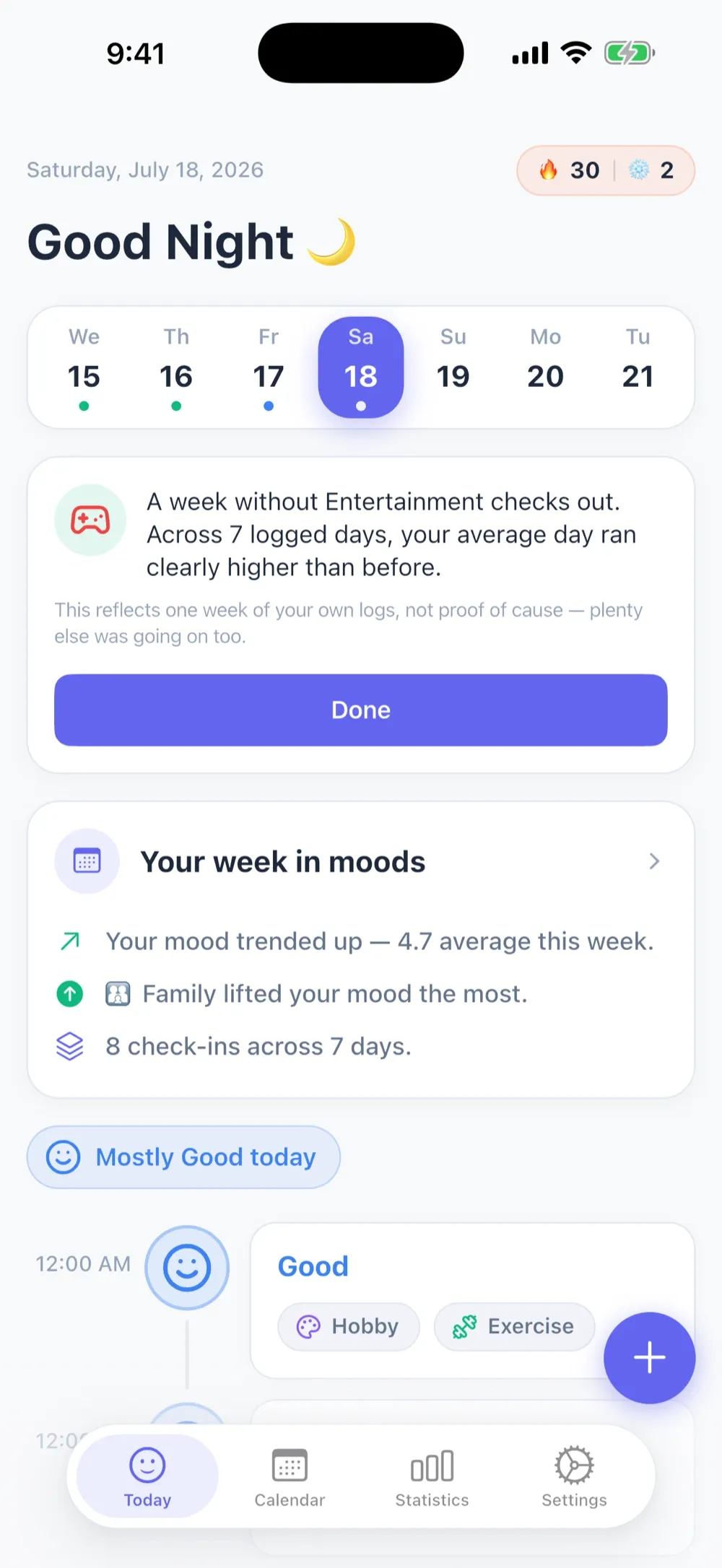
A small trick that helps: add a custom mood called “dread” alongside the standard five. Naming the specific feeling makes the Sunday entries stand out in the log, and it makes the feelings-wheel exercise of separating dread from tiredness automatic.
Reading the weekday pattern
After two or three weekends, one of these shapes will be looking back at you:
| What the log shows | What it usually means | What to try |
|---|---|---|
| Sunday low, Monday noon fine | Anticipatory dread | A 15-minute Sunday plan for Monday; move the scary task to Tuesday |
| Sunday low, Monday low, short sleep tagged | Weekend sleep debt | Same wake time on weekends; test a late-Saturday cutoff |
| Saturday high, Sunday sliding all day | Weekend-end contrast | Put your best activity on Sunday, not Saturday |
| Low only on weekends with alcohol or late nights tagged | Hangover, in the broad sense | A skip-week on the culprit, then compare |
| Low every day, Sunday just louder | Not a Sunday problem | See the burnout and anxiety notes below |
The tags do the work here. A “late night” tag next to your worst Sundays, and absent from your best ones, is the kind of thing MoodKit’s Impact Leaderboard flags without you having to hunt for it, because it ranks every tag by its measured effect on your mood.
Four fixes worth a one-week experiment
Pick one. Running four changes at once tells you nothing about which one worked.
- The Sunday plan. Fifteen minutes writing Monday’s first three tasks. Cheap, and the classic fix for dread.
- A Sunday main course. Move the weekend’s best activity (the hike, the long call with a friend, the cooking) to Sunday afternoon so the day has something in it besides the countdown.
- The Saturday cutoff. Bed by a set time on Saturday. MoodKit’s next-day experiment is built for this one: it measures whether a late Saturday hurts Sunday’s mood, using the sleep data your phone or watch already writes to Apple Health.
- A phone-free Sunday evening. Doom-scrolling reliably worsens mood, and Sunday evening is peak scroll.
Each of these fits a one-week self-experiment: do it for seven days, compare against your baseline, get a verdict. MoodKit runs these natively and is perfectly willing to report that the Sunday plan did nothing for you. That’s useful too; it saves you from doing it forever.
When it isn’t really about Sundays
Two patterns mean the Sunday framing is too small. If the log is low most days and the weekend barely lifts it, read the burnout tracking guide, because a weekend that stops recharging you is one of the earliest signals. If the dread is broad, physical, and hard to pin to work, the anxiety-focused round-up covers tools for that, and a doctor or therapist is the right next call. A mood log helps that conversation; it doesn’t replace it.
MoodKit’s limits, for the record: iPhone and iPad only, no Apple Watch app, and no permanent free tier after the trial ($39.99 a year or $79.99 once). What it does have is the weekday view, the activity ranking, and the experiments, which is most of what the Sunday problem needs.
Frequently asked questions
What are the Sunday scaries?
The wave of dread, restlessness, or low mood that arrives on Sunday afternoon or evening ahead of the working week. Clinicians describe it as anticipatory anxiety: your mind runs ahead to Monday and loads the stress early. It's common and not a diagnosis.
Do the Sunday scaries mean I'm in the wrong job?
Not by themselves. Surveys find a large majority of workers get them, including people who like their jobs. Logging for a couple of weeks tells you whether the dread is about work specifically, about a short night's sleep, or about a weekend that didn't recharge you.
How long does it take to see a Sunday pattern?
MoodKit surfaces your best and worst weekdays after seven entries, and two weeks of daily check-ins is enough to compare Sundays with the rest of the week. A month gives you enough Sundays to trust the pattern.
Does MoodKit have a Sunday-specific feature?
No special Sunday mode. Its Weekly Rhythms view shows how each day of the week scores, its Impact Leaderboard ranks the activities you tag, and its one-week experiments let you test one fix at a time.
Keep reading

How to Find Your Mood Triggers (With Data, Not Guesswork)
A practical method for identifying what really sets off your bad days: build a suspect list, log context for two weeks, read the patterns, then test one change.
· 3 min read
Self-Experiments: Test What Actually Lifts Your Mood
The n-of-1 method for mood: how to test one habit for one week and get an answer you can trust — including the traps that fool most self-experimenters.
· 4 min read

Sleep and Mood: Stop Guessing, See It in Your Own Data
Fifty years of research says sleep loss drags mood down. Here's how to measure the effect in your own life with Apple Health and a two-week log.
· 3 min read