The Dopamine Menu, Data-Tested: Keep What Actually Works

The MoodKit Team
· 4 min read

The dopamine menu graduated from TikTok trend to legitimate coping tool somewhere in the last two years. Popularized by Jessica McCabe of How to ADHD, the idea is a pre-decided list of rewarding activities, formatted like a restaurant menu, that you reach for when you’re stuck or understimulated instead of defaulting to the infinite scroll. Researchers who’ve looked at it are cautiously positive about the mechanism: sustained, low-level rewards like movement, music, and social contact fit what stimulation-seeking brains actually need better than the phone’s fast spikes do.
Here’s the problem nobody mentions: most menus are written in five optimistic minutes and never audited. The items are guesses about what recharges you, and some guesses are wrong. You know how to fix that. Measure. (Disclosure: we build MoodKit, whose core feature happens to be exactly this measurement, so it shows up in steps 3 and 4.)
Draft the menu in courses
Steal the standard restaurant structure:
| Course | Job | Examples |
|---|---|---|
| Appetizers | 5-minute resets between tasks | One song loud, ten push-ups, step outside, pet the cat |
| Mains | 30+ minute genuine recharges | A walk, gym session, cooking, a hobby project, calling a friend |
| Sides | Bolt-ons that upgrade a boring task | Music while cleaning, podcast on the commute, fancy coffee at the desk |
| Desserts | Fun but costly in excess, portioned | Gaming, one episode, social feeds with a timer |
| Specials | Rare, high-effort, high-reward | Day hike, concert, museum morning |
Two drafting rules. Write items you’ve actually enjoyed in the past month, not ones that photograph well. And keep it to five to eight items total; a menu you can’t read in five seconds won’t get read at the moment it exists for.
Make every item a tag
Now wire the menu into your mood log. Each menu item becomes an activity tag (MoodKit ships 24 built-in activities and takes any custom ones), and you keep doing the fifteen-second check-ins from the basic tracking method: a 1-to-5 mood plus whatever tags apply, several times a day if you like.
That’s the whole overhead. No extra journaling, no ratings per activity, just tags riding along on entries you’re making anyway.
Let the leaderboard promote and fire items
After two weeks or so, the data starts talking. MoodKit’s Impact Leaderboard ranks your activities by their measured effect on your mood, with day counts shown, and Hidden Patterns flags combinations you’d never test deliberately (the walk plus podcast that outperforms either alone, say).
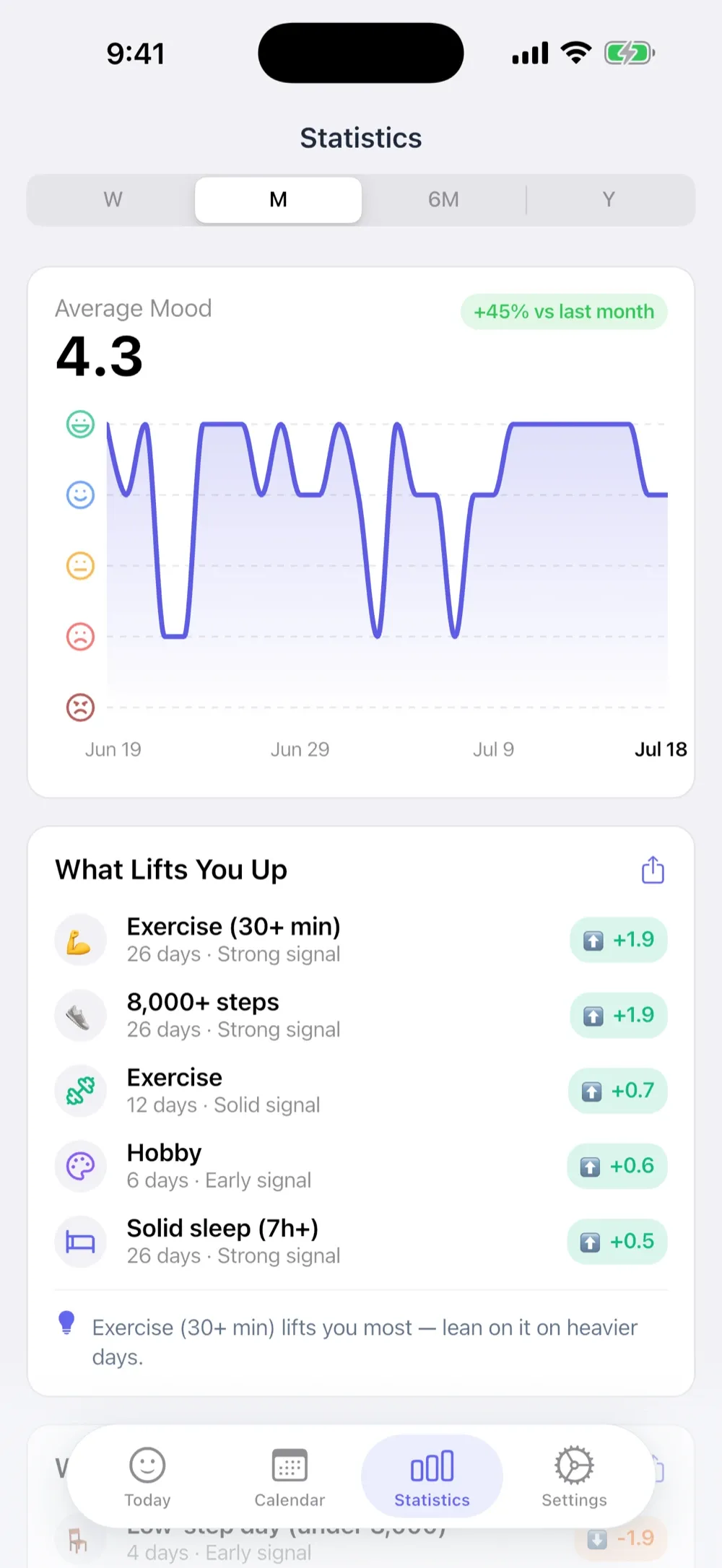
Read it like a chef reads sales:
- Promote the items that punch above their weight. If “ten minutes outside” keeps showing up attached to your best afternoons, move it from appetizer to daily main.
- Fire the imposters. Every menu has one: the activity that feels like self-care and measures like a mood-neutral time sink. Ours was a certain puzzle game. This is also where desserts earn their portion sizes; if an hour of feeds reliably precedes your 2-out-of-5 evenings, the data has opinions about the serving.
- Watch for one-way doors. Some desserts read fine same-day and bill you tomorrow via sleep. If a wearable writes sleep to Apple Health, MoodKit folds it in as a driver and its next-day analysis catches exactly this pattern.
A fair caveat: two weeks of tags is evidence, not proof, and correlations can lie. Which is why the last step exists.
Audit one item per week, properly
For anything you’re about to promote into a daily slot, run it through a one-week self-experiment: do it daily for seven days, compare against baseline, get a verdict. MoodKit runs these natively, including skip-a-habit weeks for testing whether a suspicious dessert was quietly dragging you down. The verdict is computed from your own entries and is entirely willing to tell you the beloved item did nothing.
That’s the difference between a dopamine menu as aesthetic and a dopamine menu as tool. The trend gave you the format; your data decides the dishes. If ADHD is part of your picture, the companion piece on friction-proofing the tracking itself makes the measuring part stick.
Frequently asked questions
What is a dopamine menu?
A pre-written list of enjoyable activities, organized like a restaurant menu (quick appetizers, substantial mains, desserts to ration), that you pick from when you're stuck, understimulated, or about to doom-scroll. Deciding in advance is the trick: it removes the choosing step at exactly the moment your brain is worst at choosing.
Do dopamine menus only help people with ADHD?
They were popularized in the ADHD community, where the stimulation-seeking logic fits best, but the mechanism (a default list that outcompetes the phone) is useful to almost anyone whose reflex reward is scrolling.
How do I know if a menu item actually helps me?
Track it. Tag the activity when you use it, log your mood, and after a couple of weeks compare moods on days with and without it. An app that ranks activities by measured mood effect automates the comparison.
How many items should be on a dopamine menu?
Short beats complete: five to eight items you'd genuinely do beats twenty aspirational ones. A menu is only useful if reading it takes five seconds.
Keep reading

Mood Tracking With ADHD: Design for the Brain You Have
Emotional ups and downs are core ADHD territory, and most trackers quietly assume a brain that remembers to log. Here's a setup that survives yours.
· 4 min read
Self-Experiments: Test What Actually Lifts Your Mood
The n-of-1 method for mood: how to test one habit for one week and get an answer you can trust — including the traps that fool most self-experimenters.
· 4 min read
How to Track Your Mood: The Complete 2026 Guide
A practical system for mood tracking that survives real life: picking a scale, tagging context, staying consistent, reading patterns, and testing changes.
· 5 min read