Glimmers, Measured: Find the Small Moments That Actually Lift You
The MoodKit Team
· 4 min read

Everyone tracks their triggers. Almost nobody tracks the other half of the ledger, which is odd, because the other half is where the good days come from.
“Glimmers” is the word therapist and author Deb Dana gave to the small cues of safety that nudge a nervous system toward calm: morning light on your skin, a stranger’s genuine smile, the cat settling on the laptop. She framed them as the opposite of triggers, and the framing stuck; the word has had a long second life on social media as a gentle counter to the trigger-hunting most self-improvement content runs on.
MoodKit has its own word for the measured version. At 30 entries it reports your personal catalysts alongside your triggers, the activities with the strongest measured pull on your mood in each direction. That’s what this article is about: taking glimmers from something you notice to something you can rank. (Disclosure: we build MoodKit. One caveat on the theory: the polyvagal model the term comes from is contested among physiologists, and you don’t need to settle that argument to run what follows. Not medical advice.)
Glimmers versus triggers
Both are cues. A trigger is a cue your system reads as threat; a glimmer is one it reads as safety. The practical differences are size and attention. Triggers tend to be big and get noticed; glimmers are small and get missed, because a nervous system that’s on guard is scanning for the next threat, not the next patch of sunlight.
Which is why noticing is taught as a skill, usually as “find one glimmer a day.” That’s a fine practice, and the nervous-system regulation guide covers where it sits among the others. The problem is that noticing has no memory. A month later you know you’ve had glimmers; you don’t know which ones mattered.
Noticing is a skill; tagging makes it stick
The fix is to attach each glimmer to a mood check-in. In MoodKit that’s a custom activity: either a general “glimmer” tag for the noticing practice, or, better, specific ones. First coffee. Morning light. Cat. A text from a particular friend. Ten minutes of music. The walk past the bakery. Each becomes a tag you add to a fifteen-second check-in, with a two-word note if you want to remember the specifics.
That’s the whole overhead, and it has a side effect worth mentioning: deciding which tag to use makes you look for glimmers, which is the noticing practice, done for free.
| Glimmer type | Examples | How to tag it |
|---|---|---|
| Sensory | Sun on skin, first coffee, rain on the window | One tag per sense that reliably lands (“light,” “coffee”) |
| Social | A friend’s text, a stranger’s smile, being thanked | A tag for the person, or “kindness received” |
| Environmental | Trees, water, an empty park bench | ”Green,” which the nature guide splits further |
| Small competence | Finishing a task, a clean desk, a fixed bike | ”Small win,” attached to the check-in after |
Two weeks later: which glimmers are catalysts
After a couple of weeks of tagging, MoodKit’s Impact Leaderboard ranks every activity by its measured effect on your mood, with the day counts alongside, and Hidden Patterns flags combinations you’d never test deliberately (the coffee-plus-light morning that outperforms either alone). At 30 entries the catalysts-and-triggers report names the strongest of each.
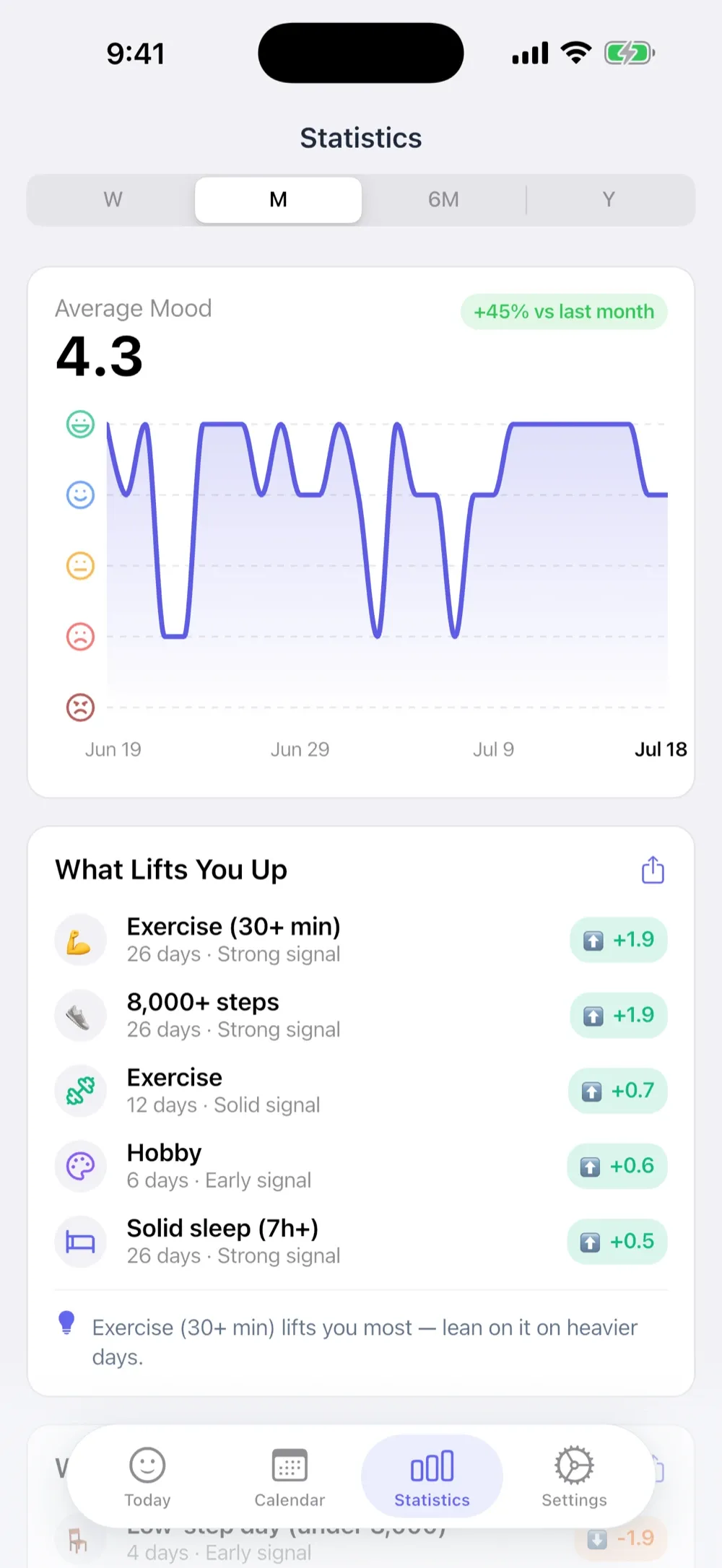
Expect a lopsided result, and expect most glimmers not to make the cut. A single glimmer is usually too small to move a 1-to-5 score on its own; that’s fine, and not a failure of the practice. The leaderboard’s job is to find the two or three that do scale, the ones that show up on your best days far more often than chance. Those are your catalysts, and they’re the ones worth protecting. The triggers guide is the mirror image of this section, for the other column.
Turning a glimmer into a habit
A catalyst is a glimmer you can schedule. Once the data says morning light or the bakery walk reliably sits on your good days, run it as a one-week try-a-habit experiment: every day for seven days, then a verdict computed from your own entries against your baseline. If it holds up as a deliberate habit and not just a happy accident, it graduates to the daily list. The micro-acts of joy protocol is the active version of the same idea, for glimmers you make rather than find.
MoodKit’s limits here: it won’t prompt you to look for glimmers, it can’t attach a photo of one (no photo or audio attachments), there’s no Apple Watch app, and there’s no permanent free tier after the trial ($39.99 a year or $79.99 lifetime). What it does is the part your memory can’t: keep the ledger’s good column, and tell you which entries in it are real.
Frequently asked questions
What are glimmers?
Tiny moments that cue your nervous system toward calm and safety: the first sip of coffee, sun on your arm, a dog leaning on your leg, a stranger holding a door. The term frames them as the opposite of triggers, which cue threat.
Who coined the term glimmers?
Deb Dana, a clinician who translated Stephen Porges's polyvagal theory into practical language for therapy. The word spread well beyond therapy rooms on social media from 2022 onwards.
Are glimmers scientifically proven?
The polyvagal framework behind the term is debated among physiologists. The practice itself, deliberately noticing and savoring small positive moments, has independent support in positive-psychology research. Tracking lets you skip the theory argument and check what your own glimmers do to your mood.
How do I track glimmers?
Add a custom activity for the glimmer (or a general "glimmer" tag), attach it to a quick mood check-in when one happens, and after a couple of weeks compare your mood on days with and without it. An app that ranks activities by measured mood effect does the comparing for you.
Keep reading
How to Find Your Mood Triggers (With Data, Not Guesswork)
A practical method for identifying what really sets off your bad days: build a suspect list, log context for two weeks, read the patterns, then test one change.
· 3 min read

Nervous System Regulation: Prove Your Practice Works
Breathwork, cold plunges, somatic resets: wellness's biggest 2026 trend is easy to start and hard to evaluate. A mood log turns it into a fair test.
· 3 min read

Micro-Acts of Joy: Run the 7-Day Big Joy Protocol on Your Data
17,598 people did one small joyful act a day for a week and reported better mood, less stress, and better sleep. Here's how to run the seven days and measure yours.
· 4 min read