Nervous System Regulation: Prove Your Practice Works
The MoodKit Team
· 3 min read

Nervous system regulation is having its moment: Forbes calls it wellness’s latest obsession, the Global Wellness Summit filed neurowellness among 2026’s biggest trends, and your feed has the breathwork reels to match. The pitch lands because the problem is real: sustained stress arousal, bad sleep, no boundaries, permanent low-grade alarm. Nobody needs convincing that calmer would be better.
Here’s the underexamined part: almost every practice in this trend is cheap to start and never gets evaluated. People breathe in boxes for a month, feel vaguely better or vaguely silly, and can’t say which. Vague is fixable. You have a phone, the outcome you care about is “how my days feel,” and that’s measurable to one decimal place. (Disclosure: we build MoodKit, a mood tracker whose self-experiments exist for exactly this kind of question. The method below also works with paper and stubbornness.)
Pick one practice, define one dose
The trend bundles a dozen practices; testing the bundle tells you nothing. Pick one and give it a dose you’d bet on sustaining:
- Slow breathing: 5 minutes of physiological-sigh or box breathing, twice a day.
- Cold exposure: 30 to 60 seconds of cold at the end of a shower.
- Somatic reset: a 10-minute body-scan or shake-out after work.
- Outdoor decompression: 15 minutes outside before opening the laptop.
Write the dose down. “I’ll breathe more” is not a testable claim; “5 minutes after coffee and before bed, daily, for a week” is.
Baseline before belief
Two weeks of ordinary mood logging before you start: a 1-to-5 once or twice a day, tags for the obvious stress inputs (work crunch, conflict, caffeine, short sleep). This is the boring step that makes the later verdict mean something, because without a baseline every practice “works” via fresh-start enthusiasm. That enthusiasm effect is well documented in the research on why self-tracking misleads people, and it wears a lab coat convincingly.
If a wearable writes sleep to Apple Health, connect it; MoodKit reads sleep, exercise, and steps as driver factors, and stress practices often show up in the sleep column before the mood column.
Run the week like an experiment, not a vibe
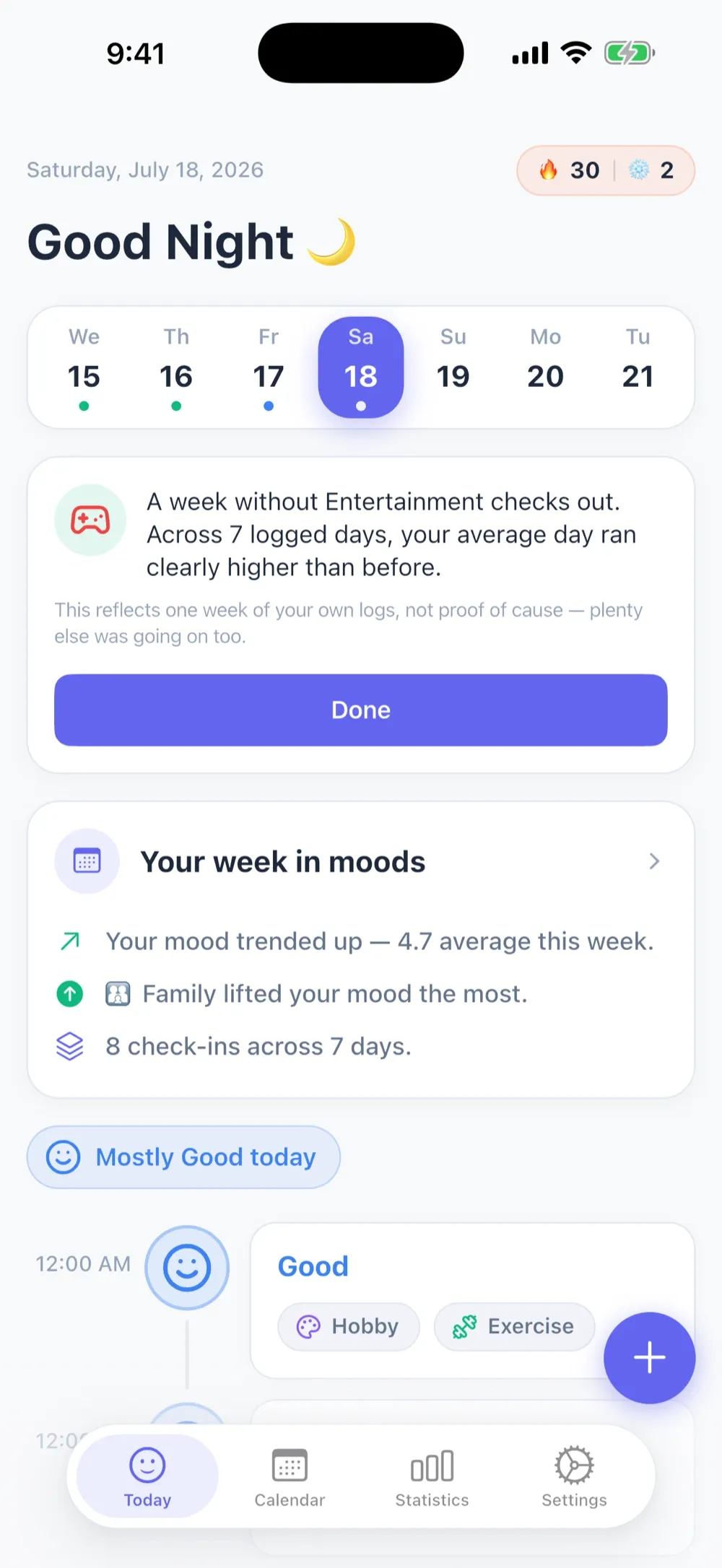
Now the practice week: do the dose daily, tag it, change nothing else on purpose. This is a straight try-a-habit self-experiment, and MoodKit runs the whole shape natively: it holds the window, compares against your baseline, and returns a verdict computed from your own entries, including the unflattering verdicts. A streak with banked freezes keeps the logging alive on the days the practice itself wobbles.
Three readings to look at when the week ends:
- Average shift. Did practice-week days genuinely sit above baseline, or within noise? MoodKit applies a steadiness band rather than celebrating every +0.1.
- Bad-day behavior. Some practices don’t raise the average; they shorten the tail. Fewer 1s and 2s with the same mean is a real and underrated win, visible right in the calendar’s color.
- Next-day effects. Evening practices especially tend to pay out the following morning through sleep. The sleep-mood pipeline is where to look.
HRV gadgets versus the felt day
The trend’s hardware wing wants you measuring heart rate variability with a ring or a strap, and fair enough: HRV is a legitimate physiological window, and watching your own biometrics respond is motivating. Two cautions from the data-minded corner. A single metric invites chasing the metric (sleeping “for the score” is already a documented failure mode of sleep trackers), and HRV is a proxy: the actual deliverable of nervous system regulation is days that feel less like an emergency. A mood log measures the deliverable directly, costs nothing, and pairs happily with any gadget you already own. If forced to choose, our vote goes to the log; ideally, don’t choose.
The wellness industry will keep shipping trends; that part’s not in your control. What is: the next practice that reaches you gets a dose, a week, and a verdict from your own numbers. Keep the ones that clear the bar. It’s a calmer relationship with the trend cycle, which, come to think of it, is nervous system regulation too.
Frequently asked questions
What is nervous system regulation, in plain terms?
An umbrella term for practices meant to shift you out of chronic fight-or-flight arousal: slow breathing, cold exposure, somatic exercises, time outdoors, and similar. The physiology behind stress arousal is real; how much any given practice helps any given person is the open question.
Do I need an HRV wearable to know if it's working?
No. HRV gadgets measure one physiological proxy; a consistent mood log measures the thing you actually care about, how your days feel. Ideal is both, but the mood log is free and harder to fool with a single good night.
How long should I test a practice like breathwork?
A week of daily practice against a two-week baseline gives a usable first verdict for mood effects. Practices that plausibly build slowly deserve a second week before you judge them, but most show something within one.
What if a practice works but I hate doing it?
Then it will quietly exit your life, and its measured benefit goes with it. Test the tolerable version too (three minutes instead of ten): a smaller effect you'll sustain beats a bigger one you'll abandon by October.
Keep reading
Self-Experiments: Test What Actually Lifts Your Mood
The n-of-1 method for mood: how to test one habit for one week and get an answer you can trust — including the traps that fool most self-experimenters.
· 4 min read
Does Mood Tracking Actually Work? What the Research Says
The honest evidence on mood tracking: what studies show it helps with, where the benefits stop, the illusory-correlation trap, and how to track so it works.
· 3 min read

Sleep and Mood: Stop Guessing, See It in Your Own Data
Fifty years of research says sleep loss drags mood down. Here's how to measure the effect in your own life with Apple Health and a two-week log.
· 3 min read