Micro-Acts of Joy: Run the 7-Day Big Joy Protocol on Your Data
The MoodKit Team
· 4 min read

In June 2025 researchers at UC San Francisco published the results of the Big Joy Project, a free online program in which participants did one small, joyful act a day for a week. After analyzing 17,598 people from 169 countries, the team reported meaningful gains in emotional wellbeing (effect size d = 0.48), positive emotion (0.45), lower stress (−0.35), and modestly better sleep (0.15), with a clear dose-response: the more days people completed, the bigger the gains. Younger and socially disadvantaged participants benefited most.
That’s a large, cheap, fast effect from something that takes minutes. It’s also a study with no control group and self-reported outcomes, which the authors acknowledge, so the right response is neither “this is settled” nor “this is fluff.” It’s “run it on yourself and see.” (Disclosure: we build MoodKit, which runs exactly the kind of one-week experiment this calls for. Not medical advice.)
The acts
The paper describes seven daily micro-acts adapted from validated positive-psychology exercises, each designed to take under ten minutes. The ones the researchers highlight in their public summaries: ask someone to share a fun, inspiring, or proud moment; write a gratitude list; do a kind act to brighten someone’s day. The rest come from the same families of exercise, and here is a seven-day set built from them that we’ve used ourselves. It isn’t the official list, and it doesn’t need to be; the point is one act, once a day.
| Day | Act | Family |
|---|---|---|
| 1 | Ask a friend to tell you about a moment they’re proud of | Connection |
| 2 | Write three specific things you’re grateful for today | Gratitude |
| 3 | Do one small kindness for a stranger or colleague | Kindness |
| 4 | Watch or step into something vast: a skyline, a storm, a piece of music | Awe |
| 5 | Take a five-minute walk and count the things you’d normally miss | Savoring |
| 6 | Congratulate someone on good news, properly, in full sentences | Celebrating others |
| 7 | Take one stressful thing from this week and write what it taught you | Reframing |
Run it as a one-week experiment
The study measured before and after. You can do better, because you can measure during, and you can compare against a baseline the study didn’t have for you.
- Baseline first. Log your mood for a week or two before you start, fifteen seconds a check-in. Without this, “I felt better” is unfalsifiable.
- Make the act a tag. Add a custom activity called “micro-act” and tag it on the check-in you make after each day’s act.
- Start the experiment. MoodKit’s try-a-habit experiment takes a habit, watches it for seven days, and compares the week against your baseline. At the end you get a verdict, computed from your own entries, and it’s willing to say “no measurable effect.”
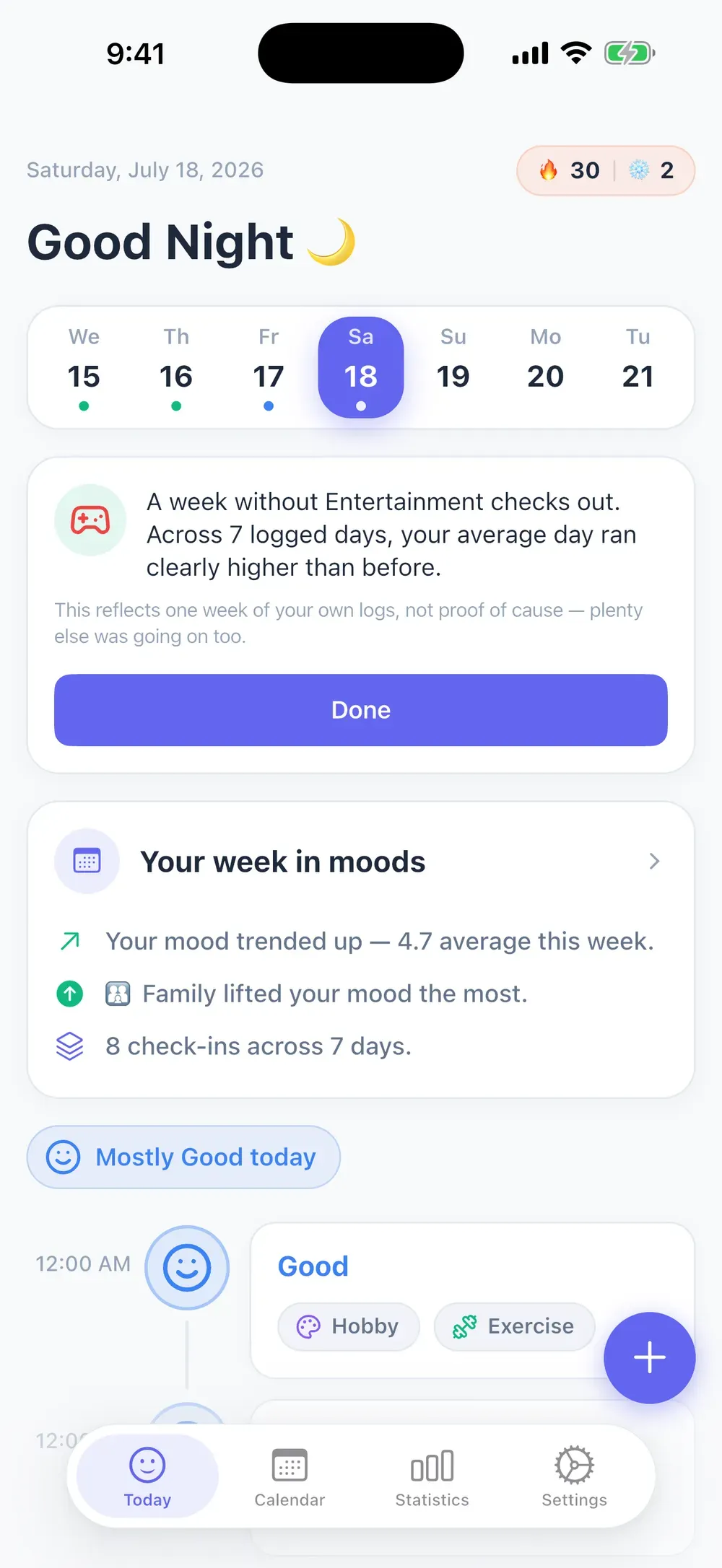
The study’s effect sizes are a useful yardstick. A d of 0.48 on wellbeing is a noticeable shift, not a transformation; on a 1-to-5 mood scale, expect something like a few tenths of a point if you match the average. If your week shows more, good. If it shows nothing, the second week below is where it gets interesting.
Which act carried the week
The published study can’t tell you which of the seven acts did the work; participants did all seven, and the analysis is of the bundle. You’re not stuck with that.
Run a second week with each act as its own tag (“gratitude,” “kindness,” “awe,” and so on). After a couple of weeks, MoodKit’s Impact Leaderboard ranks each tag by its measured effect on your mood, with day counts shown, and the answer tends to be lopsided. In our own logs, connection acts were worth roughly three of the others put together, and the awe day did nothing at all. Yours will look different, which is the entire point of measuring.
Why the effect fades, and what to keep
The dose-response finding cuts both ways. More days meant bigger gains in the study, which strongly suggests the gains recede when the days stop. That’s not a flaw in the intervention; it’s how most mood levers work, and the practical response is to keep the two or three acts that measured best and let the rest go. A daily kindness plus a weekly gratitude list is sustainable. Seven rotating acts forever is not.
Two companion ideas fit here. The dopamine menu is a way to keep your winning acts written down for the days you can’t think. And glimmers are the passive cousin of micro-acts: small good moments you notice rather than make, which respond to the same tagging treatment.
MoodKit’s limits, for the record: it won’t send you the day’s act (it’s a tracker, not a prompts app; the journal prompts list is the closest we have), it has no Apple Watch app, and there’s no permanent free tier after the trial ($39.99 a year or $79.99 lifetime). What it adds to the Big Joy Project is the one thing 17,598 participants didn’t get: a verdict about themselves.
Frequently asked questions
What is a micro-act of joy?
A deliberate action that takes under ten minutes and is drawn from a well-studied positive-psychology exercise: writing a short gratitude list, doing a small kindness, asking someone to share a proud or inspiring moment. The Big Joy Project assigned one a day for seven days.
Did the Big Joy study have a control group?
No. It was a single-group, before-and-after study of 17,598 self-selected participants, published in the Journal of Medical Internet Research in June 2025. That's a real limitation, and one more reason to test the protocol on your own data rather than take the average on trust.
How long does the protocol take each day?
The acts were designed to take less than ten minutes, and most take two or three. Adding a fifteen-second mood check-in afterwards is what turns the week into an experiment.
How do I measure whether it worked for me?
Log your mood for a week or two before you start, then run the seven days as a tracked habit and compare. An app that runs one-week experiments and delivers a verdict automates the comparison.
Keep reading

30 Mood Journal Prompts That Take Two Minutes or Less
Short, specific prompts for morning, evening, bad days, and weekly reviews, built for check-ins you'll still be doing in December, not day-one essays.
· 4 min read

Glimmers, Measured: Find the Small Moments That Actually Lift You
Glimmers are the opposite of triggers: tiny cues of safety and joy. Noticing them is step one. Tagging them for two weeks shows which ones reliably lift your mood.
· 4 min read
Self-Experiments: Test What Actually Lifts Your Mood
The n-of-1 method for mood: how to test one habit for one week and get an answer you can trust — including the traps that fool most self-experimenters.
· 4 min read